
Mixing Decorating Styles: The Principles Behind Spaces That Feel Cohesive, Not Chaotic

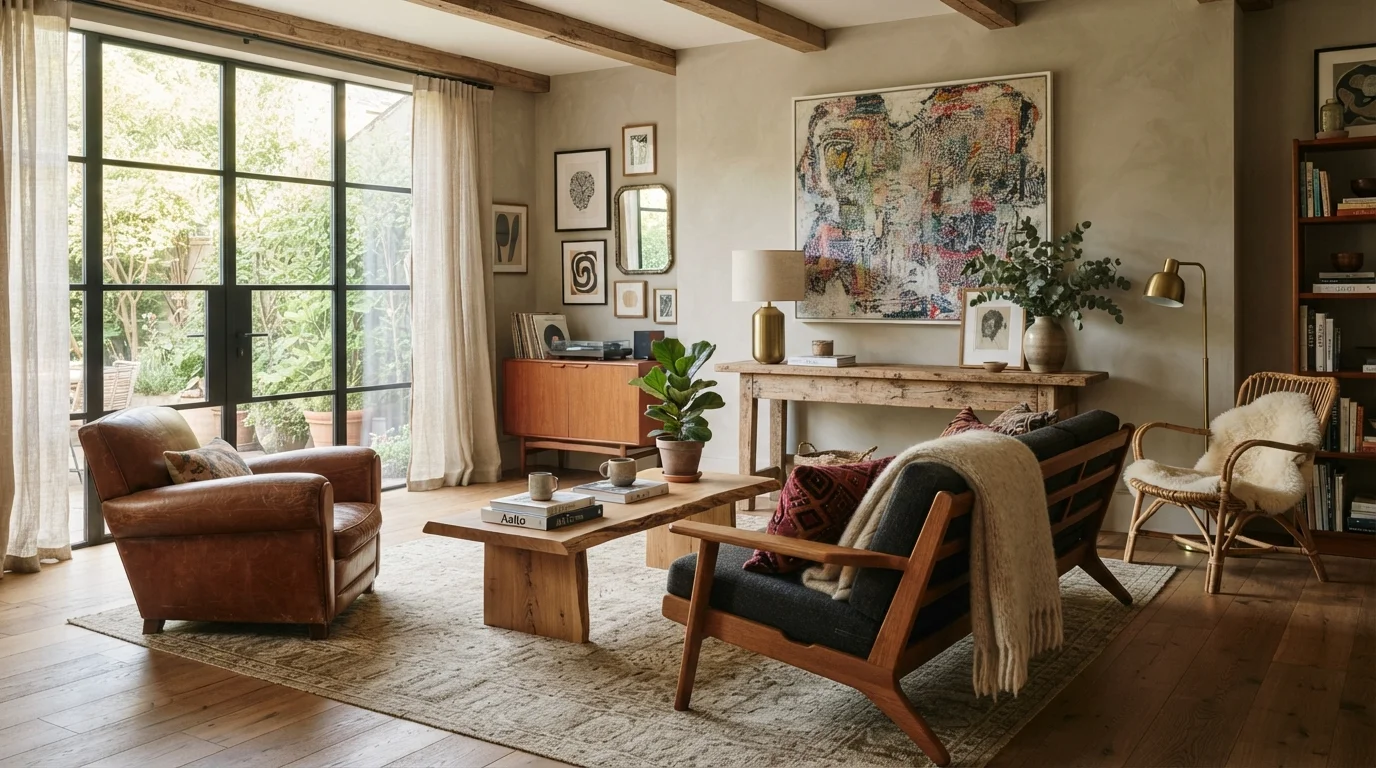
Photo: faqsvault.com editorial
Key Takeaways
- A shared color palette is the single most reliable thread for uniting different decorating styles.
- Repeating one or two design elements — texture, finish, or shape — creates visual rhythm across varied pieces.
- Visual weight balance prevents any one style from dominating and making a room feel lopsided.
- Intentional contrast between styles reads as curated; accidental contrast reads as chaotic.
- Anchor pieces that clearly define the room's primary style make it easier to layer secondary influences.
Why Mixed Styles Work — and When They Don't
The idea that every room must commit to a single decorating style — all farmhouse, all mid-century modern, all minimalist — is one of the most persistent myths in interior design. In practice, the rooms that feel most personal and alive are almost always a blend. The challenge isn't whether to mix styles; it's understanding how to do it so the result feels deliberate rather than disjointed.
When mixing styles goes wrong, it's rarely because the individual pieces are bad. It's because the room lacks a unifying strategy. Two equally beautiful chairs from different eras can clash if they share no visual language — different scale, different finish, different color temperature, nothing in common. The goal is to give every element in the room a reason to belong together, even if their origins are completely different.
For a deeper look at some widely held decorating assumptions worth questioning, see common decorating myths challenged.
Start With a Unifying Color Palette
Color is the fastest, most reliable way to create cohesion across different styles. When a warm cream sofa in a traditional silhouette sits beside a sleek industrial steel side table, what makes them coexist peacefully is often something as simple as a shared warm undertone running through the metal finish, a throw pillow, or the wall color behind them.
A practical approach: choose two or three anchor colors and ensure each major piece in the room references at least one of them. This doesn't mean everything needs to match — it means nothing should be so tonally isolated that it looks like it wandered in from a different room entirely.
How color shapes a room's mood goes deeper into color theory for interiors, but the core principle here is restraint: limit your palette, then use it consistently across styles.
Test Your Palette With a Mood Board First
Use Repetition to Create Visual Rhythm
Repetition is what transforms a collection of individual objects into a room that reads as composed. When the same texture, material, or shape recurs across otherwise different pieces, your eye registers a pattern — and pattern signals intention.
In practical terms, this might mean repeating a natural wood tone across a Scandinavian-style coffee table, a traditional carved side chair, and a set of framed artwork. The pieces don't share a style, but they share a material language. Similarly, repeating a curved silhouette — in a rounded mirror, a curved lamp base, and an arched doorway detail — can stitch together pieces from very different design periods.
Layering natural materials is one of the most effective ways to build this kind of repetition because natural textures tend to read as warm and grounded regardless of style era.
Balance Visual Weight Across the Room
Visual weight refers to how much attention a piece commands relative to everything around it. A heavily carved antique armoire carries significant visual weight; a glass-topped coffee table carries very little. When all the heavy pieces cluster in one area and the other side of the room feels sparse and lightweight, the space feels unbalanced — even if each individual piece is beautiful.
When mixing styles, visual weight becomes especially important because different styles tend toward different scales and ornamentation levels. A maximalist baroque-influenced piece paired with spare Japandi furniture needs careful placement so neither overwhelms the other. Try distributing heavier elements diagonally across the room rather than grouping them together.
If the room itself is compact, this balancing act becomes even more consequential. The strategies in decorating small rooms with character address how to manage scale and weight in tighter footprints.
Anchor the Room With a Dominant Style
Even the most eclectic room benefits from having one primary style that accounts for roughly 60 to 70 percent of what's visible. This anchor style sets the room's overall personality and gives secondary pieces a clear context to react to. Without it, a room can feel stylistically directionless — not curated eclecticism, but unresolved indecision.
Your anchor style is usually determined by your largest and most permanent pieces: the sofa, the flooring, the architectural features of the room itself. A room with exposed brick walls and raw timber beams already has a strong industrial-rustic anchor; the mixing challenge then becomes choosing accent pieces that complement without competing. A room with a classic tufted sectional has a traditional anchor that can absorb contemporary art and modern lighting fixtures with ease.
Missteps often happen when two equally dominant styles compete for the same space. Decorating decisions that make rooms feel off covers exactly this kind of imbalance and how to course-correct.
Lighting also plays a quietly powerful role in how mixed styles land. The right fixture can feel simultaneously modern and warm, bridging style gaps that furniture alone can't. See how lighting shapes a room's feel for a fuller picture of this often-overlooked tool.
All published content on this website is for informational and educational purposes only and should not be taken as professional advice. We recommend that readers seek expert opinion before making any decisions. The website is not responsible for any actions taken based on the information provided on this website. We are not liable for any inaccuracies, modifications, or omissions in information. Moreover, external links or third-party content are provided for convenience; we are not liable for their correctness. Users are advised to verify every piece of information before they use it for any purpose.