
The Myths Decorators Wish You'd Stop Believing

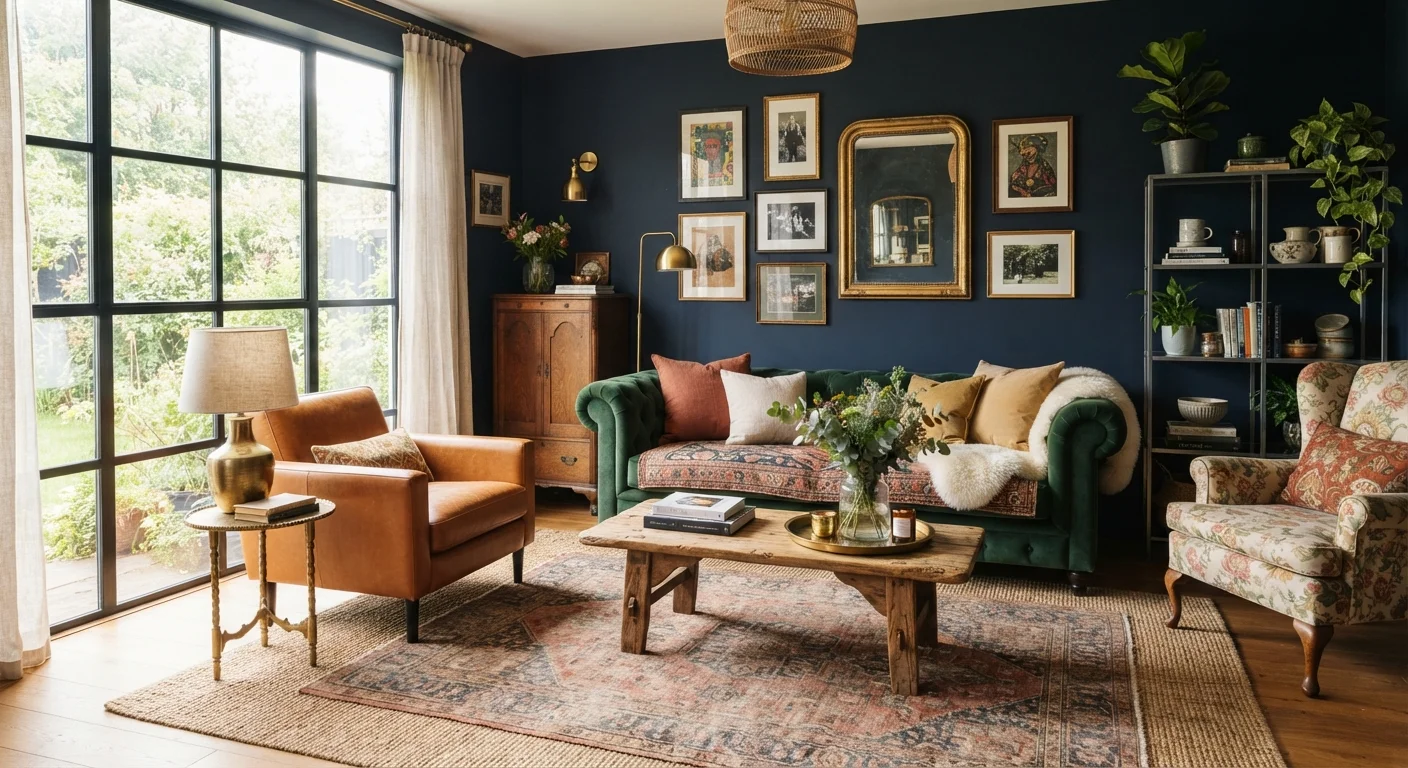
Photo: faqsvault.com editorial
Key Takeaways
- Dark wall colors can actually make a room feel more intimate and layered, not smaller.
- Mixing metal finishes is an accepted and often recommended design technique.
- You do not need to spend heavily to achieve a well-decorated, cohesive space.
- Matching everything too closely can make a room look flat and uninspired.
- Good lighting often does more for a room's feel than any paint color or furniture choice.
Why Decorating Myths Persist — and Why They Hold You Back
Decorating advice spreads fast. A phrase heard from a parent, spotted in a magazine, or repeated confidently on a home improvement show can calcify into a "rule" that people follow for decades — even when it was never really true in the first place. These myths tend to stick because they feel logical on the surface, but they collapse quickly under closer examination.
The cost of believing them isn't just aesthetic. Rigid rules discourage experimentation, keep budgets stretched toward unnecessary purchases, and prevent homeowners from trusting their own instincts. Before you repaint, rearrange, or replace anything based on a decorating "should," it's worth asking where that rule actually came from — and whether it holds up.
Below, we break down the most persistent myths decorators encounter and offer a clearer, more flexible picture of what actually works. For a broader look at how different design choices interact, our guide to mixing decorating styles is a useful companion read.
Myth
Dark wall colors make a room feel smaller and more oppressive.
Fact
Dark colors can actually create depth and intimacy, making a room feel intentional and well-designed rather than cramped.
This myth assumes that walls are the primary factor in how large a space feels. In reality, perceived room size is influenced by ceiling height, furniture scale, natural light, and the contrast between surfaces. A deep charcoal or forest green on four walls can read as moody and sophisticated in a room with adequate lighting — and in a small space, it can even make the boundaries feel less noticeable rather than more so.
The rooms that feel oppressive are typically ones with poor lighting and oversized furniture, not ones with saturated wall color. If you want to experiment with a darker shade, pay equal attention to your light sources. Our guide on lighting as decoration explains how fixture placement and bulb temperature interact with paint color.
Myth
You should never mix metal finishes in the same room.
Fact
Mixing metal finishes is a widely used design technique — the key is intentionality, not uniformity.
The idea that all metals in a room must match — every fixture, every handle, every lamp base — tends to produce spaces that feel stiff and overly coordinated. In practice, designers often combine warm metals like brass or copper with cooler ones like brushed nickel or matte black to create visual interest and layering.
The technique works best when one finish is dominant and others appear as accents, and when the mixed metals share a consistent tonal quality — for example, all warm, or all matte. Mixing a polished chrome with a burnished bronze can feel jarring, while pairing matte black with aged brass typically reads as intentional and curated.
Myth
Everything in a room should match for it to look pulled-together.
Fact
Too-perfect matching often makes a room feel flat. Variation in texture, tone, and scale creates visual richness.
A "matchy-matchy" room — where every cushion, curtain, and accessory repeats the same color family and material — can feel more like a showroom floor than a lived-in home. Designers use contrast deliberately: a rough linen throw against a smooth velvet sofa, a weathered wood coffee table beside a contemporary upholstered chair.
What makes a room feel cohesive isn't identical elements — it's a consistent underlying logic. That might be a shared color temperature, a repeated shape, or a consistent level of visual weight. Mixing styles successfully relies on exactly these principles of contrast and repetition rather than uniformity.
Myth
You need a big budget to decorate well.
Fact
Thoughtful editing, proportion, and placement matter far more than the price tag on individual pieces.
Expensive furniture and accessories don't automatically produce a well-decorated room. What creates a sense of quality and intention is how things are arranged, how scale is handled, and how much clutter is avoided. A room with fewer, better-placed pieces almost always looks more considered than one filled with expensive items arranged without thought.
Budget-conscious decorating often works in its favor — constraints force decisions about what genuinely matters in a space. Prioritizing a well-scaled rug, good task lighting, and a single anchor piece (like a sofa or bed frame) can do more for a room than accumulating many decorative objects. Avoid the common trap of using small-scale furniture to try to "save space" — pieces that are too small for the room are among the most frequent missteps, as explored in our piece on decorating decisions that backfire.
Myth
White walls are always the safest, most versatile choice.
Fact
White can be just as challenging as any other color — and it isn't always the neutral it's assumed to be.
White walls are often chosen as a default "safe" option, but white paint varies enormously in undertone — a cool blue-white in a north-facing room can feel clinical and cold, while a yellow-tinted white in a warm-light room may read as off-white or dingy. Getting white right actually requires the same careful observation as any other color choice.
Beyond undertone, all-white rooms depend heavily on texture and contrast to avoid feeling stark. Without variation in materials — matte plaster, warm wood, layered textiles — a white room can feel unfinished rather than minimal. Choosing white intentionally is perfectly valid; choosing it to avoid making a decision is where it tends to fall flat.
Putting the Myths to Work: Practical Takeaways
Knowing a myth is false is only the first step. The more useful question is: what do you actually do instead? The answer is almost always the same — observe your specific space, your light conditions, and what you're drawn to, rather than defaulting to a generic rule.
Start with one area where a myth has been holding you back. If you've avoided dark paint in a small bedroom, consider testing a sample swatch across a full wall panel and live with it for a few days under different lighting conditions. If you've been forcing matching metals, pick up a single fixture or accessory in a contrasting finish and see how it reads in context.
Don't Swap One Rigid Rule for Another
Common decorating missteps often have less to do with color or metal choices and more to do with scale, proportion, and furniture placement — factors that are easy to overlook when you're focused on surface details. Our article on decorating decisions that backfire covers these in depth. And if you're starting a full room refresh, the pre-redecorating planning checklist can help you avoid the most common planning gaps before you commit to a direction.
Ultimately, the most confident decorators aren't the ones who know the most rules — they're the ones who understand which rules are worth bending. Lighting, in particular, is one variable that shapes every other choice you make in a room. Our piece on lighting as decoration explains why bulb temperature and placement deserve as much attention as any paint color or furniture selection.
All published content on this website is for informational and educational purposes only and should not be taken as professional advice. We recommend that readers seek expert opinion before making any decisions. The website is not responsible for any actions taken based on the information provided on this website. We are not liable for any inaccuracies, modifications, or omissions in information. Moreover, external links or third-party content are provided for convenience; we are not liable for their correctness. Users are advised to verify every piece of information before they use it for any purpose.