
Bluetooth Speakers vs. Portable Radios: Which Fits Your Lifestyle Better?

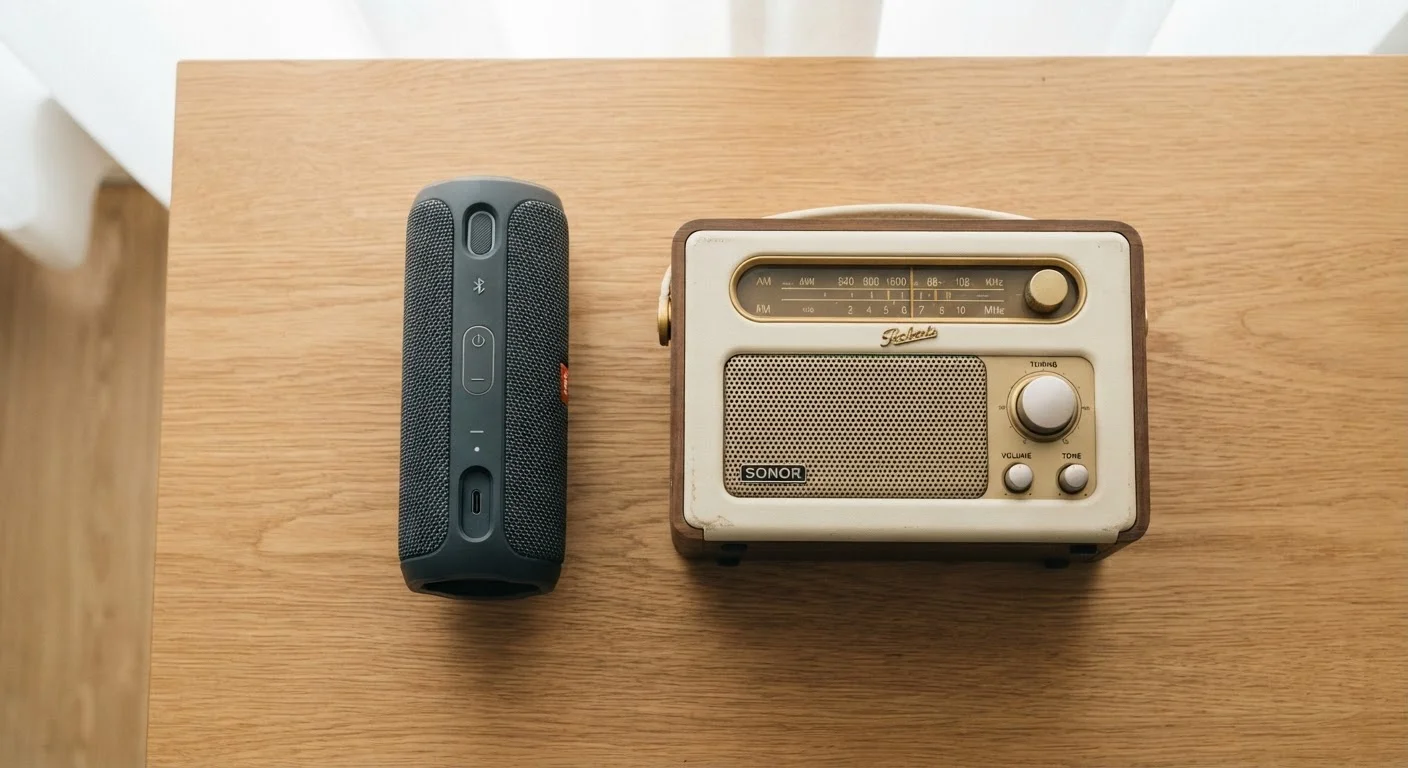
Photo: faqsvault.com editorial
Key Takeaways
- Bluetooth speakers stream audio from your phone or tablet but require a paired device and charged batteries.
- Portable radios receive over-the-air broadcasts independently — no smartphone, Wi-Fi, or subscription needed.
- Battery life tends to favor radios, which can run for days on AA batteries or a single charge.
- Bluetooth speakers generally offer wider audio format flexibility and modern sound quality.
- Emergencies and outdoor reliability often make portable radios the more dependable choice.
- Your listening habits — not specs — should drive which device fits your everyday life.
How Each Device Actually Works
Understanding the basic technology behind each device makes it easier to judge which one fits your habits. If you want a refresher on terms like Bluetooth or wireless protocols, see our Everyday Gadget Glossary before diving in.
A Bluetooth speaker connects wirelessly to a nearby device — typically a smartphone, tablet, or laptop — and plays whatever audio that device sends to it. Bluetooth is a short-range radio standard (usually effective within about 30 feet) that creates a direct link between your phone and the speaker. No internet connection is required for the link itself, but the audio content — a Spotify playlist, a podcast, a YouTube video — usually streams from the internet through your phone first.
A portable radio works entirely differently. It picks up broadcast signals transmitted over the air by radio stations — AM (Amplitude Modulation) for talk and news, FM (Frequency Modulation) for music. No phone, no app, no Wi-Fi, and no subscription. You tune to a frequency and listen. Some newer models also receive DAB or weather-band signals, but the core principle remains the same: the radio is a receiver, not a streamer.
For a broader look at how wireless standards are evolving, our piece on wireless technology today provides useful context.
Connectivity, Convenience, and Setup
Setup experience differs sharply between the two. Pairing a Bluetooth speaker typically takes under a minute — hold the button, select the device on your phone, done. But it does require a compatible source device, and occasional re-pairing glitches are a real annoyance some users report. If your phone battery dies, so does your music.
A portable radio requires no setup at all. Extend the antenna, turn the dial, find a station. There are no accounts to log into, no apps to update, and no passwords to remember. For less tech-savvy users or older adults, this frictionless experience can be a genuine advantage rather than a compromise.
| Bluetooth Speaker | Portable Radio | |
|---|---|---|
| Requires smartphone or source device | Yes | No |
| Typical battery life | 8–20 hours (rechargeable) | 40–100+ hours (replaceable batteries) |
| Setup complexity | Pair via Bluetooth app or settings | Tune antenna, select frequency |
| Content variety | Unlimited (any phone audio) | Limited to local broadcast stations |
| Works without internet | Yes (link), but content often needs data | Yes, fully independent |
| Emergency weather alerts | Not supported | Supported (weather-band models) |
| Sound quality control | High — depends on source audio | Variable — depends on signal strength |
| Best environment | Home, outdoor gatherings, travel | Camping, emergencies, low-tech use |
One nuance worth noting: Bluetooth audio quality has improved considerably in recent years, with modern codecs (the compression formats audio uses during transmission) delivering rich, detailed sound. FM radio, by contrast, is an analog signal whose quality depends heavily on your distance from a transmitter and local interference.
Battery Life and Reliability in the Field
Battery performance is one of the most practical dividing lines. Bluetooth speakers typically offer between 8 and 20 hours of playback on a built-in rechargeable battery, depending on volume and model. When the battery runs out, you need a power outlet or a charging cable — and recharging can take several hours.
Portable radios, particularly those running on replaceable AA or AAA batteries, can operate for 40 to 100+ hours of continuous use on a single set. That longevity matters in camping, travel, and especially emergencies. When a storm knocks out power for days, a portable radio becomes a critical tool for staying informed — something a Bluetooth speaker simply cannot replicate without a charged source device.
NOAA Weather Radio, a U.S. government broadcast network, is receivable only on devices equipped with a weather band — a feature built into many portable radios but absent from Bluetooth speakers. This alone makes portable radios worth considering for households in regions prone to severe weather.
Sound Quality, Content, and Everyday Use Cases
Sound quality is another dimension where context matters more than raw specs. Bluetooth speakers can play any audio your phone can access — millions of songs, podcasts, audiobooks, internet radio stations from around the world, and more. The variety is essentially unlimited. For gatherings, beach days, or background music at home, this flexibility is hard to match. If you enjoy live music in various settings, you might also appreciate how audio quality varies by environment — similar to the way our piece on concerts vs. festivals explores how venue format shapes the listening experience.
Portable radios are limited to what's broadcasting in your area. In rural regions, that might mean only a handful of stations. In dense metro areas, the selection is broader. What radios lack in variety they compensate in reliability: the signal is simply there, no buffering, no algorithm, no subscription required.
For listeners who prefer passive, low-effort audio — turning something on and letting it play — radio offers a genuinely different experience than on-demand streaming. Morning news routines, talk radio habits, and background noise throughout a workday are all natural fits.
Which One Should You Choose?
Neither device is objectively better — they're built for different listeners. Ask yourself a few practical questions before deciding:
- Do you primarily listen from a smartphone? A Bluetooth speaker is likely the more seamless fit.
- Do you want something that works without a phone, app, or internet connection? A portable radio wins on independence.
- Is battery longevity critical — for camping, travel, or outages? Portable radios have a clear edge.
- Do you want to stream diverse content — podcasts, playlists, audiobooks? Bluetooth speakers offer far more flexibility.
Some users find they want both: a Bluetooth speaker for daily streaming and a portable radio stashed away for emergencies or outdoor use. That's a reasonable approach, and the cost of a basic portable radio is low enough that it doesn't have to be an either/or decision. Whatever you choose, prioritize how you actually listen day-to-day rather than chasing specs you may never use.
Curious how similar trade-offs play out with phone charging? Our comparison of wired vs. wireless charging applies the same practical lens to another everyday technology decision.
All published content on this website is for informational and educational purposes only and should not be taken as professional advice. We recommend that readers seek expert opinion before making any decisions. The website is not responsible for any actions taken based on the information provided on this website. We are not liable for any inaccuracies, modifications, or omissions in information. Moreover, external links or third-party content are provided for convenience; we are not liable for their correctness. Users are advised to verify every piece of information before they use it for any purpose.