
Viral vs. Cultural: Why Some Trends Disappear Overnight and Others Reshape Society

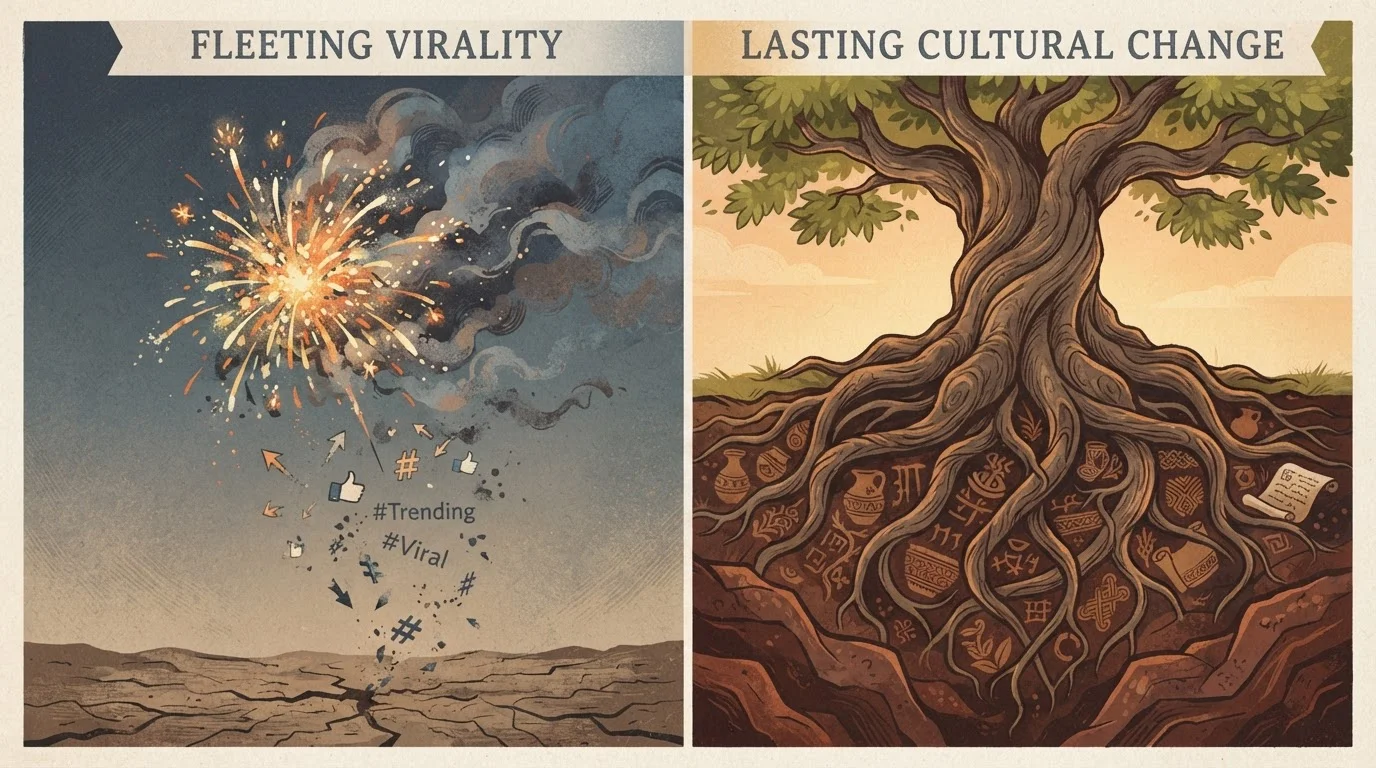
Photo: faqsvault.com editorial
Key Takeaways
- Viral trends spread fast through novelty and emotion; cultural shifts spread slow through repeated, meaningful adoption.
- The lifespan of a trend is often measured in days; the lifespan of a cultural shift can span decades.
- Not all viral moments are trivial — some serve as early signals of deeper cultural change already underway.
- Platform algorithms favor novelty, which accelerates virality but can also accelerate forgetting.
- Cultural shifts typically involve behavior change, not just awareness, and are felt across institutions and communities.
- Understanding the difference helps you read social moments more clearly rather than overreacting or underreacting.
The Speed Problem: Why We Confuse One for the Other
Every week, something new dominates the internet. A sound bite, a dance format, a phrase that appears on seemingly every feed simultaneously. And then, just as quickly, it's gone — replaced by the next thing before most people have processed the first. In this environment, it's genuinely difficult to tell which moments matter and which ones simply moved fast.
The confusion is understandable, and it's not just a consumer problem. Journalists, brands, and even researchers sometimes treat virality as a proxy for cultural significance. But the two operate on entirely different logics. Virality is a distribution event. Cultural change is a value-restructuring event. One can happen in 48 hours; the other typically takes years — sometimes generations.
Understanding how trends move through the social ecosystem is a useful starting point, because it reveals that most trends follow a recognizable arc: emergence in a subculture, mainstream adoption, saturation, and decline. What separates the ones that stick from the ones that vanish is not how many people saw them — it's what people did differently as a result.
What Viral Trends Actually Are — and Aren't
A viral trend is, at its core, a piece of content or behavior that spreads rapidly across networks because it triggers a strong, immediate emotional response — humor, surprise, outrage, or recognition. The spread is largely mechanical: social platforms are built to surface content generating engagement, and engagement is rewarded with wider distribution. Novelty and emotional intensity do most of the work.
This does not make viral trends meaningless. They are genuine windows into collective mood. When a particular meme format lands, it often reflects something people were already feeling but hadn't yet articulated. The "relatability" that drives sharing is real. But relatability is not the same as transformation. A viral moment that makes millions of people laugh at the same thing does not necessarily change how any of them think, vote, spend money, or treat one another.
What viral trends characteristically lack is durability in behavior. They generate awareness — sometimes enormous awareness — but awareness alone rarely rewires habits, institutions, or social norms. Trend fatigue is partly a product of this cycle: when everything feels urgent and then immediately irrelevant, the emotional tax accumulates.
| Criterion | Viral Trends | Cultural Shifts |
|---|---|---|
| Typical lifespan | Hours to weeks | Years to decades |
| Primary driver | Novelty, emotional reaction, algorithm | Accumulated behavior and value change |
| Behavioral change required | Rarely — attention is enough | Yes — habits, norms, institutions shift |
| Measurable in real time | Yes — metrics are immediate | Rarely — often visible only in retrospect |
| Institutional response | Uncommon | Common — policies, programs, norms adjust |
| Demographic reach | Often concentrated in specific groups | Crosses demographic lines broadly |
| Can signal deeper change | Sometimes — if conditions are right | Yes — reflects change already underway |
What Cultural Shifts Actually Look Like
Cultural shifts are slower, messier, and harder to see in real time. They are not announced by a single viral post. Instead, they accumulate across thousands of small moments — conversations that shift tone, policies that quietly change, products that disappear from shelves or proliferate on them, social scripts that begin to feel outdated. By the time most people name a cultural shift, it has already been underway for years.
Consider how attitudes toward mental health discussion changed in the United States over roughly two decades. No single moment caused it. A combination of factors — advocacy, research entering public discourse, generational openness, media representation — slowly moved the needle until talking openly about therapy, anxiety, or burnout stopped being transgressive and started being ordinary. That is a cultural shift. It changed behavior, language, and institutional responses like workplace wellness programs.
Pop culture moments can accelerate these shifts, but they rarely cause them alone. A film, a performance, or a viral event typically works as a catalyst when it lands on ground that was already prepared — when the underlying conditions for change were already present and the moment gives them a visible shape.
The Diagnostic Questions Worth Asking
When a trend crosses your feed and feels significant, a few questions can help you assess whether you're watching a flash or a wave. First: does participation require a behavior change, or just attention? Sharing a meme requires only attention. Changing how you talk to your kids, restructuring your diet, or reconsidering a vote requires behavior change. Shifts tend to involve the latter.
Second: is the engagement broad and structurally diverse, or concentrated in a specific demographic or platform? Viral trends often concentrate in particular communities before fading. Cultural shifts tend to cross demographic lines and appear in unexpected places — in legislation, in product design, in school curricula, in how employers write job listings.
Third: is there an institutional response? When companies change policies, governments pass laws, or schools revise programs in reaction to a social moment, that's a sign something is shifting at a structural level — not just capturing attention. Reading these signals carefully, without overreading them, is a skill worth cultivating.
A Note on Confusing Speed with Significance
When Viral and Cultural Overlap
The relationship between these two phenomena is not purely oppositional. Some viral moments are early-stage cultural shifts in visible form. The memeification of social movements has made this dynamic especially complex: serious causes sometimes travel through humor and virality, making it hard to know whether lasting change is being built or simply performed.
The honest answer is that both can be true simultaneously. A viral hashtag can raise genuine awareness that outlasts the trend cycle, if it connects to organizing infrastructure, policy conversations, and communities willing to do the slower work. The viral moment is the spark; the cultural shift is what happens if the right conditions exist to sustain a flame.
What's worth resisting is the assumption that reach equals impact, or that disappearing from the feed means disappearing from consequence. Some of the most significant cultural changes in recent memory arrived quietly — and some of the loudest viral moments left almost no trace. Even nostalgia cycles follow this logic: what gets revived is rarely what was most viral in its moment, but what quietly embedded itself into how people felt about a particular era.
All published content on this website is for informational and educational purposes only and should not be taken as professional advice. We recommend that readers seek expert opinion before making any decisions. The website is not responsible for any actions taken based on the information provided on this website. We are not liable for any inaccuracies, modifications, or omissions in information. Moreover, external links or third-party content are provided for convenience; we are not liable for their correctness. Users are advised to verify every piece of information before they use it for any purpose.