
Third Places: The Underappreciated Spaces That Hold Communities Together

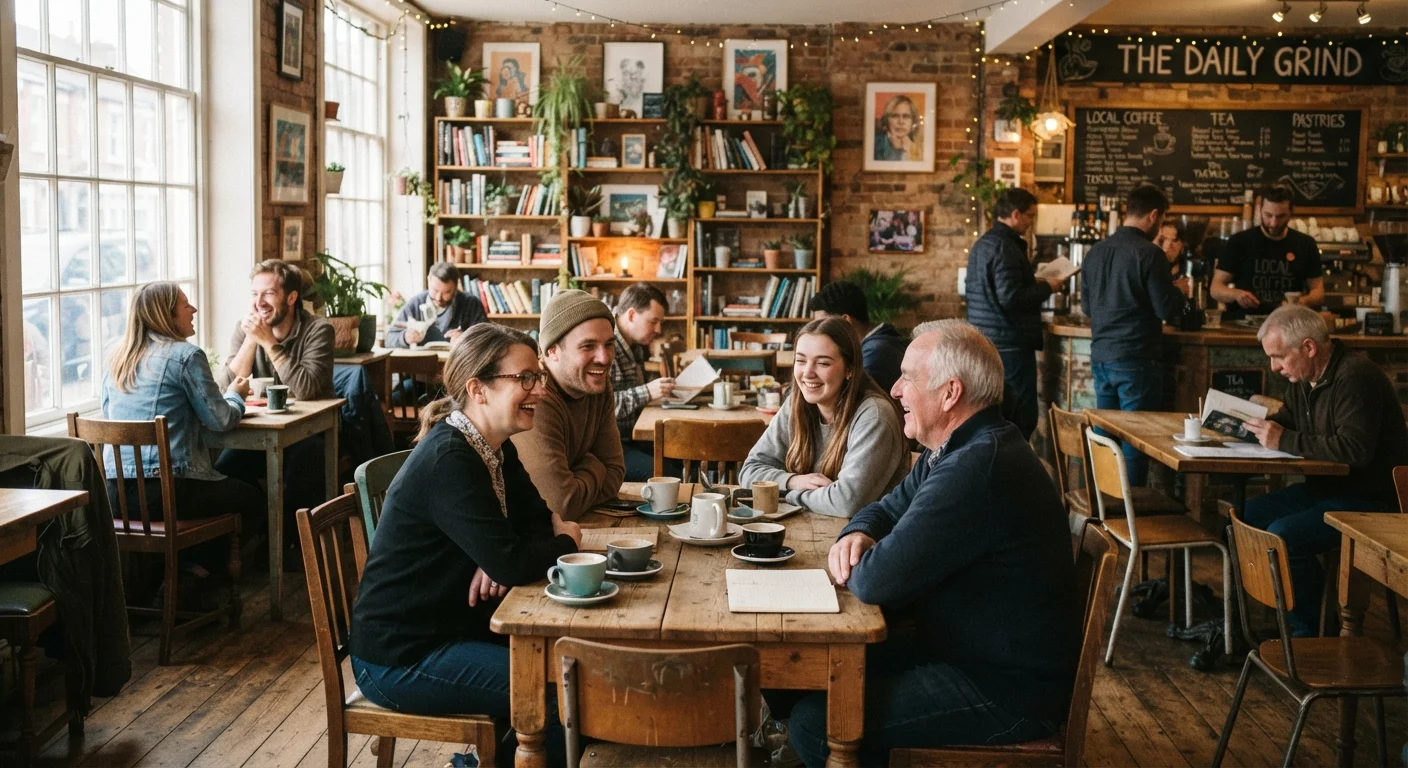
Photo: faqsvault.com editorial
Key Takeaways
- Third places are informal public spaces between home and work that quietly sustain community life.
- They lower social barriers, allowing people of different backgrounds to interact as equals.
- The decline of third places is linked to growing feelings of loneliness and disconnection.
- Libraries, parks, barbershops, and community centres all function as third places in everyday life.
- Protecting and funding these spaces is increasingly recognized as a public health and social priority.
The Space Between Home and Work
Most people can name the coffee shop they stop at on the way to the office, the park bench where they've run into the same dog walker a dozen times, or the library branch where the staff know their name. What's harder to articulate is why these places feel so different from everywhere else — more comfortable, more open, more alive with the kind of casual human contact that rarely gets scheduled in advance.
Sociologist Ray Oldenburg gave these spaces a name in 1989: third places. His argument was deceptively simple. If home is where we recover and work is where we produce, then third places are where we simply exist alongside other people — no agenda required. They are the social infrastructure that democracies and neighbourhoods quietly depend on, even when nobody is thinking about them that way.
Understanding what third places are — and what happens when they disappear — has become more urgent in an era when loneliness is increasingly recognized as a widespread concern. For readers interested in the broader forces shaping contemporary connection, why third places are experiencing a cultural renaissance is worth exploring further.
What Makes a Space a Third Place?
Not every public space qualifies. A mall food court is public, but its commercial pressure and transient foot traffic don't invite lingering. Oldenburg identified a set of qualities that genuine third places tend to share:
- Neutral ground: No one is obligated to be there, and no one hosts or owns the social dynamic.
- A levelling effect: Status markers from work or social class fade into the background. The regulars at a neighbourhood barbershop span professions and incomes.
- Conversation as the main activity: Talk — casual, wandering, unhurried — is what happens there.
- Accessibility and accommodation: They are easy to get to and cheap or free to use.
- A cast of regulars: The rhythm of familiar faces is what turns a space into a place.
- A playful, low-key mood: There's room for humour, disagreement, and the unexpected.
By these measures, libraries, parks, barbershops, diners, community gardens, and faith community common rooms all qualify — often in ways their designers never consciously intended.
“The character of a third place is determined most of all by its regulars, who give it its character and who assure that on any given visit some of those others will be there.”
— Ray Oldenburg, Sociologist and author of 'The Great Good Place'
Why Their Absence Is Felt So Deeply
When third places thin out — through underfunding, suburbanisation, or the simple closure of a beloved local café — the loss isn't immediately visible. There's no headline. But something shifts. People report feeling more isolated, less informed about their neighbours' lives, and less anchored to their immediate community.
This is partly because third places do social work that no single institution can replicate. They are where new residents learn local norms. Where teenagers find mentors who aren't their parents. Where older adults stay connected to the world outside their homes. Fostering local connection in an age of disconnection often depends, at its root, on having somewhere to actually show up.
58%
Americans who report feeling lonely regularly
According to a 2023 report from the U.S. Surgeon General on the loneliness epidemic, more than half of American adults report measurable levels of loneliness.
1 in 3
U.S. adults who lack meaningful social interaction daily
Research cited in public health literature indicates that a significant share of adults go through most days without substantive in-person contact outside their immediate household.
17,000+
Public libraries in the United States
According to the American Library Association, the U.S. has more public library branches than McDonald's locations — underscoring the latent third-place infrastructure already embedded in communities.
The erosion of these spaces also maps onto growing concern about social fragmentation. When people lose incidental contact with those outside their immediate social circle, echo chambers deepen and neighbourly trust erodes — patterns explored in depth in what quietly fractures community bonds.
Third Places Across Different Communities
One of the most underappreciated qualities of third places is how differently they manifest across cultures and communities. For many immigrant and diaspora communities, a specific restaurant, cultural association hall, or place of worship functions as a third place that does triple duty — preserving language, transmitting heritage, and offering a landing pad in an unfamiliar city. How identity forms across borders and generations is deeply tied to access to these kinds of gathering spaces.
In rural areas, the general store, the diner, or the volunteer fire station might serve this function. In dense urban environments, a pocket park or a public library reading room can become surprisingly intimate. The form adapts; the function remains remarkably consistent — a place where showing up regularly is enough to belong.
Digital spaces have tried to fill some of this gap, and there's real value in what they offer. But as explored in what online and in-person communities each uniquely provide, the spontaneous, embodied quality of a third place — running into someone unexpectedly, overhearing a conversation that shifts your perspective — remains difficult to replicate on a screen.
Keeping Third Places Alive
Third places don't sustain themselves. Libraries require public funding and political will. Community gardens need stewardship. The neighbourhood café depends on foot traffic and economic conditions its owners can't fully control. Recognising third places as social infrastructure — as essential as roads or schools — is the first step toward protecting them.
Individual choices matter too. Choosing to linger rather than grab and go. Learning the name of the person behind the counter. Showing up to the community meeting even when nothing urgent is on the agenda. These small, repeated acts are what transform a public space into a place where a community actually lives.
For those interested in more structured approaches to building that community, what actually works when starting a community group offers grounded, practical perspective. But much of what matters starts earlier and more quietly — in the unremarkable act of returning, again and again, to a place where you are known.
Frequently Asked Questions
All published content on this website is for informational and educational purposes only and should not be taken as professional advice. We recommend that readers seek expert opinion before making any decisions. The website is not responsible for any actions taken based on the information provided on this website. We are not liable for any inaccuracies, modifications, or omissions in information. Moreover, external links or third-party content are provided for convenience; we are not liable for their correctness. Users are advised to verify every piece of information before they use it for any purpose.