
Streaming vs. Cinema: What Each Format Actually Does Better

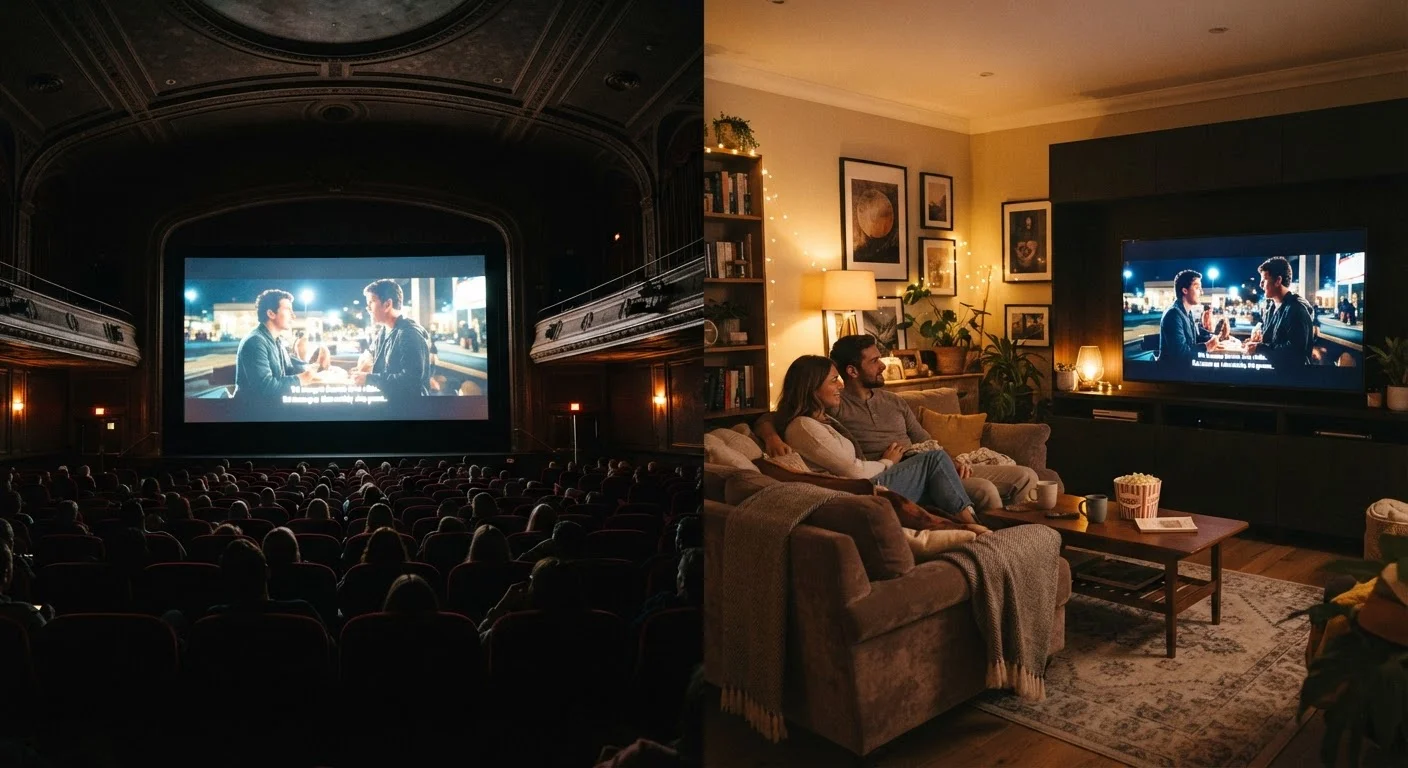
Photo: faqsvault.com editorial
Key Takeaways
- Cinema delivers unmatched immersion through scale, sound design, and communal atmosphere.
- Streaming enables longer, more complex storytelling that theatrical runtimes rarely allow.
- Both formats have shaped distinct storytelling conventions suited to their environments.
- Viewer choice, content type, and context all determine which format serves best.
- The two formats increasingly influence each other's production and distribution strategies.
The Case for Cinema: What the Big Screen Actually Does
There's a reason cinematographers, directors, and composers still talk about theatrical exhibition as the intended home for major films. Cinema isn't simply a larger TV — it's a controlled environment engineered for a specific kind of attention.
The scale of the image matters enormously for certain stories. Landscape cinematography, intricate production design, and sequences built around spatial relationships lose significant impact when compressed onto a 55-inch screen. Sound is equally significant: theatrical Dolby Atmos or IMAX audio systems create a physical, enveloping experience that consumer home audio can approach but rarely match.
Then there's the social dimension. Sitting in a packed theater for a horror film, a comedy, or a sweeping drama creates a kind of collective emotional resonance — laughter, gasps, silence — that is genuinely part of the experience. Cinema functions as a cultural event, not just a content delivery mechanism. Award shows and cultural ceremonies have struggled to maintain relevance partly because live, shared experience is increasingly rare — cinema remains one of its last reliable hosts.
For filmmakers working in visually demanding genres — action, science fiction, horror, historical epic — the theatrical frame is often the creative baseline. The director's choices about composition, pacing, and audio design are calibrated for that environment.
The Case for Streaming: What the Format Has Genuinely Unlocked
Streaming's creative advantages are frequently underestimated by those who frame it purely as convenience. The format has enabled an entirely different kind of storytelling — one that theatrical windows structurally prevent.
A two-hour film must establish character, build tension, and resolve a narrative arc within tight constraints. A streaming series — whether a limited run or an ongoing drama — can spend its first three episodes on atmosphere and character development without triggering audience walkouts. This is why some of the most psychologically complex, culturally ambitious screen storytelling of the past decade has emerged from streaming platforms. The extended runtime isn't padding; for certain stories, it's the point. For a deeper look at how format shapes creative decisions, limited series vs. ongoing shows explores these trade-offs in detail.
Streaming has also radically changed what kinds of films and stories reach audiences. International cinema — previously confined to art house theaters in major cities — is now accessible to anyone with a subscription. The global success of non-English language series and films demonstrates that the perceived barrier of subtitles was largely a distribution problem, not an audience preference. The data on foreign-language film audiences challenges many of those long-held assumptions.
| Criterion | Streaming | Cinema |
|---|---|---|
| Immersion | Varies by home setup | Engineered for maximum impact |
| Runtime flexibility | Unlimited — series can span hours | Typically constrained to 90–180 minutes |
| Access to international content | Broad, on-demand | Limited by local theatrical distribution |
| Social/communal experience | Generally solitary or small group | Shared audience in same space |
| Scheduling | On-demand, viewer-controlled | Fixed showtimes, specific locations |
| Narrative complexity | High — format supports long-form depth | Constrained by single-sitting structure |
| Cultural event quality | Lower — releases can feel diffuse | High — opening weekends generate buzz |
Access, depth of catalog, and narrative ambition are areas where streaming doesn't just compete with cinema — it operates in a genuinely different creative territory.
How Each Format Shapes the Stories Being Told
Format isn't neutral. The platform a story is made for shapes what gets made, how it's structured, and what kinds of risks creators can take.
Cinema tends to reward concept clarity, visual spectacle, and emotional efficiency. Theatrical audiences are committing two-plus hours in a specific social setting — stories that succeed there tend to be legible, propulsive, and designed to land in a single sitting. This isn't a limitation so much as a creative discipline, and the best filmmakers work brilliantly within it. Understanding how directors use that constraint — through cinematography, editing rhythm, and sound — is genuinely rewarding. Learning basic filmmaking language transforms how you watch both formats.
Streaming, by contrast, has created room for slower, stranger, more digressive storytelling. It has also, it's worth noting, produced enormous volumes of content optimised for algorithmic engagement rather than artistic ambition — a trade-off worth acknowledging. The relationship between format and quality is not straightforward.
The two formats are also increasingly cross-pollinating. Films debut on streaming days after — or simultaneously with — theatrical releases. Streaming platforms fund theatrical prestige productions. Franchise storytelling now routinely spans both formats within the same narrative universe, a complexity explored further in how cinematic universes actually work.
Viewers who engage critically with both formats are better equipped to appreciate what each is doing — and to recognize when a story has found (or missed) its ideal home. Developing a critical viewing practice is one way to deepen that engagement across both.
All published content on this website is for informational and educational purposes only and should not be taken as professional advice. We recommend that readers seek expert opinion before making any decisions. The website is not responsible for any actions taken based on the information provided on this website. We are not liable for any inaccuracies, modifications, or omissions in information. Moreover, external links or third-party content are provided for convenience; we are not liable for their correctness. Users are advised to verify every piece of information before they use it for any purpose.