
Factors That Shape a Neighborhood's Long-Term Property Value

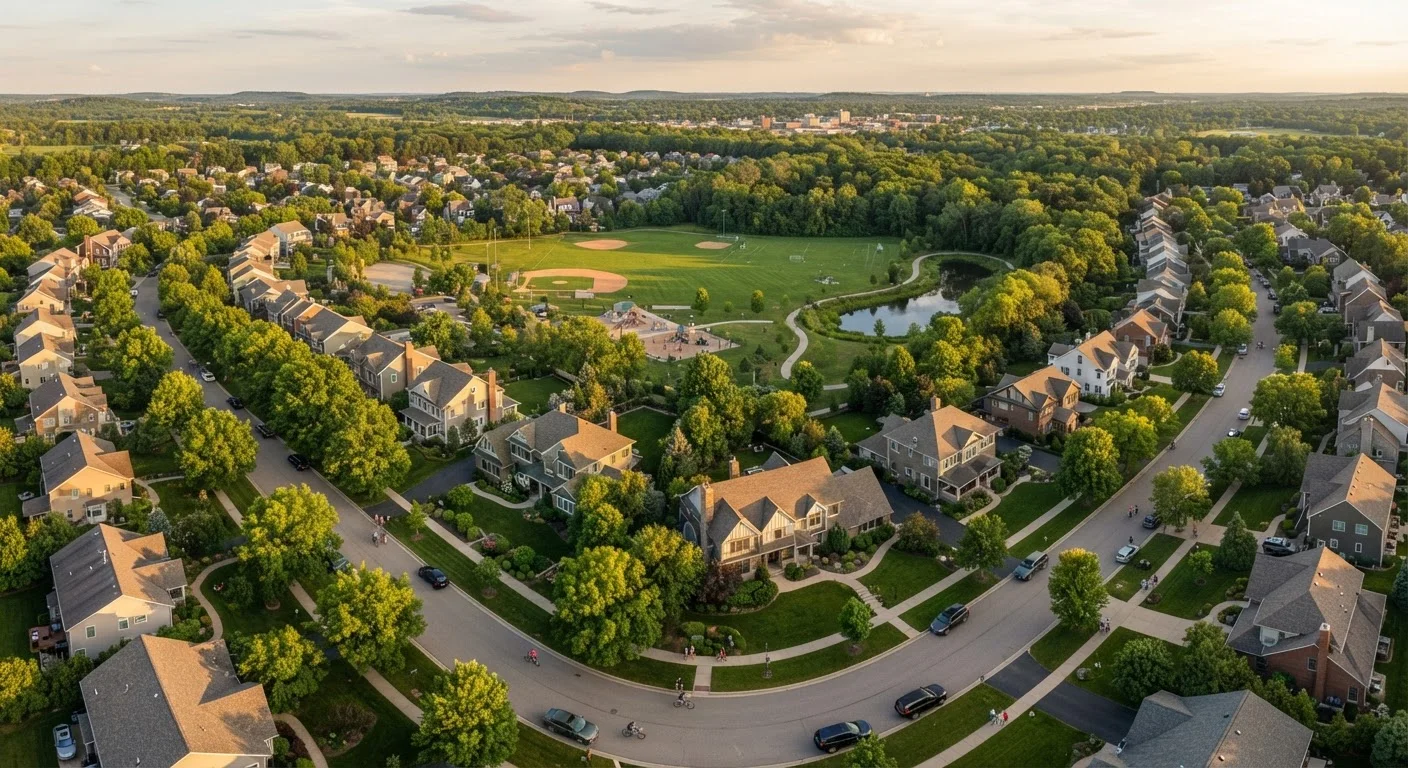
Photo: faqsvault.com editorial
Key Takeaways
- School district quality remains one of the most consistent drivers of residential property values over time.
- Proximity to employment centers and transit options makes neighborhoods more resilient during economic downturns.
- Zoning decisions and infrastructure investment signal where local governments expect long-term growth.
- Crime trends, walkability scores, and green space all factor into how buyers perceive neighborhood desirability.
- No single factor determines a neighborhood's trajectory — it's always a combination of overlapping forces.
Why Neighborhood Fundamentals Outlast Market Cycles
Home prices fluctuate with interest rates, economic conditions, and seasonal demand. But beneath those cycles, certain neighborhood-level factors exert a quieter, more durable influence on property values — one that compounds over years rather than quarters.
Understanding what those factors are matters whether you're evaluating a first purchase, considering an investment, or simply trying to make sense of why similar homes in adjacent zip codes can carry vastly different price tags. As explored in our guide on why home prices don't move the same way everywhere, the local picture almost always diverges from national headlines.
The seven factors below don't predict the future — real estate carries inherent uncertainty, and no checklist replaces professional guidance for major financial decisions. But they do capture the structural forces that analysts and experienced buyers consistently return to when assessing a neighborhood's staying power.
School District Quality
Consistently ranked among the top drivers of residential property values, school district quality influences demand even from households without school-age children. Buyers and renters alike factor school ratings into location decisions because strong districts tend to signal stable tax bases, engaged local government, and community investment.
Boundaries matter too. Properties on the same street but in different attendance zones can carry meaningfully different values — a dynamic worth investigating carefully when evaluating any specific address. Public school performance data is available through state education departments and federal reporting systems, giving buyers a concrete starting point.
School district boundaries can create measurable price differences between homes on the same street.
Access to Employment Centers
Neighborhoods within reasonable commuting distance of diverse, stable employment hubs tend to hold value better through economic downturns. When major employers anchor nearby — whether in healthcare, technology, government, or manufacturing — the surrounding residential market benefits from sustained housing demand.
The diverging trajectories of Sun Belt and Rust Belt cities illustrate this plainly: job migration shapes residential markets at a regional scale, and the same dynamic plays out at the neighborhood level.
Proximity to diverse, stable employers gives neighborhoods a buffer against economic downturns.
Transit Infrastructure and Walkability
Access to reliable public transit, bike infrastructure, and walkable amenities has grown in importance as commuting preferences have shifted and fuel costs have fluctuated. Walkability scores — which measure proximity to groceries, pharmacies, restaurants, and parks — are increasingly searchable online and cited in listing descriptions.
Areas with planned transit expansions often see property value appreciation ahead of project completion, though this involves uncertainty and timing risk. Infrastructure announcements are public record and worth monitoring through local planning department communications.
Walkable neighborhoods with reliable transit options tend to attract consistently strong buyer interest.
Zoning and Land Use Policy
Local zoning codes govern what can be built where — and changes to those codes can dramatically reshape a neighborhood's character and value trajectory. Upzoning (allowing higher-density development) can increase housing supply and attract investment, but may also alter the existing neighborhood fabric in ways that affect current residents differently depending on their situation.
Monitoring local planning commission agendas, proposed rezoning applications, and comprehensive plan updates gives early visibility into where municipal governments expect growth — or intend to preserve existing character. This information is generally public and searchable through city or county websites.
Zoning changes are among the clearest signals of where local governments expect long-term growth.
Crime Trends and Public Safety Perception
Crime statistics influence buyer perception significantly, and trends matter as much as current levels. A neighborhood with declining crime rates over several years often generates growing buyer interest even before prices fully reflect the improvement. Conversely, rising incident rates can suppress demand even in areas with other strong fundamentals.
Local police department crime maps and the FBI's Uniform Crime Reporting data provide baseline figures, though methodology varies by jurisdiction. Talking to longtime residents and understanding the neighborhood's social fabric can add context that statistics alone don't capture.
Declining crime trends often generate buyer interest before prices fully catch up.
Green Space, Parks, and Environmental Quality
Access to parks, tree canopy, waterfronts, and green corridors consistently correlates with higher property values in urban and suburban research. Beyond aesthetics, green space contributes to air quality, stormwater management, and resident wellbeing — factors that increasingly appear in municipal planning priorities.
Environmental considerations also include flood zone designations, which affect insurance costs and mortgage eligibility. FEMA flood maps are publicly accessible and an important due diligence step for any property in a low-lying or coastal area. Climate-related risk is a growing factor in how lenders and insurers assess long-term neighborhood viability.
Flood zone status and climate risk are becoming increasingly relevant to long-term property value assessments.
Demographic and Population Trends
Sustained population growth in a metro area or specific neighborhood generally supports housing demand and, over time, prices. But the composition of that growth matters too — an influx of young professionals, for example, often precedes retail and service investment that further improves neighborhood amenities.
Census data, regional planning agency reports, and permit-pulling activity by developers all offer signals about where population trends are heading. These are lagging indicators by nature, but they provide useful context for evaluating whether a neighborhood's current momentum is likely to continue. The broader US housing market guide provides useful historical context for how demographic shifts have reshaped American neighborhoods over decades.
Permit-pulling activity and regional planning data can signal where population growth is heading next.
Reading a Neighborhood's Long-Term Signals
None of these factors operates in isolation. A strong school district loses some of its pull if the local employment base is eroding. Excellent transit access matters less if crime trends are worsening. The most resilient neighborhoods tend to score reasonably well across several of these dimensions simultaneously — which is why due diligence involves looking at the full picture rather than a single standout feature.
Look Beyond Current Prices
If you're in the process of evaluating a specific area, our companion piece on questions worth asking before committing to a neighbourhood offers a practical research framework. For broader context on how market conditions affect your negotiating position once you've identified a target area, see our overview of buyer's markets vs. seller's markets.
Property value is ultimately a reflection of collective human decisions — where people want to live, what communities invest in, and how well a place adapts to economic change. Keeping an eye on those underlying signals, rather than just the price per square foot, tends to produce better-informed decisions over the long run.
This article is for general informational and educational purposes only and does not constitute financial, investment, or legal advice. Readers should consult a qualified professional before making real estate or financial decisions.
All published content on this website is for informational and educational purposes only and should not be taken as professional advice. We recommend that readers seek expert opinion before making any decisions. The website is not responsible for any actions taken based on the information provided on this website. We are not liable for any inaccuracies, modifications, or omissions in information. Moreover, external links or third-party content are provided for convenience; we are not liable for their correctness. Users are advised to verify every piece of information before they use it for any purpose.