
The Cultural Geography of Pop: How Region Shapes Sound, Style, and Story

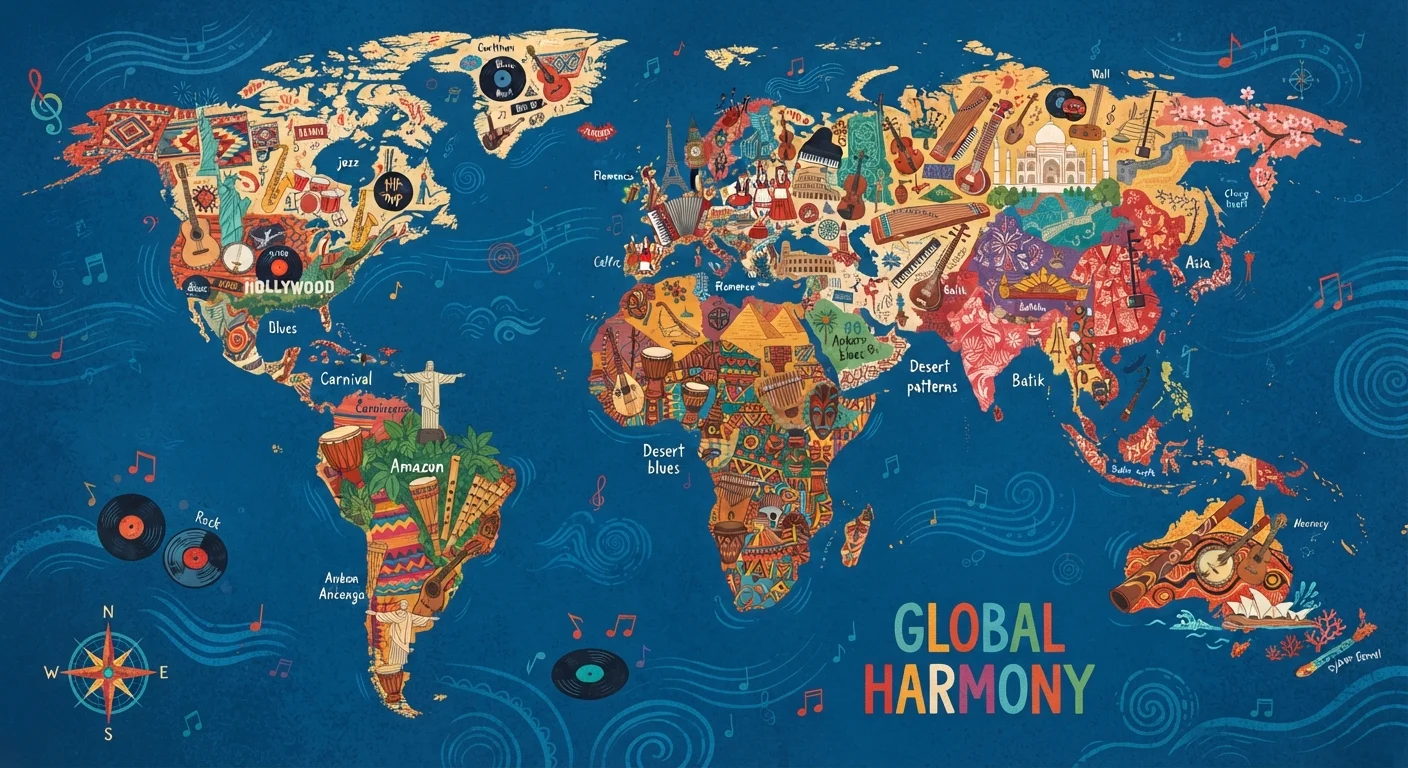
Photo: faqsvault.com editorial
Key Takeaways
- Geography shapes not just a genre's sound but its visual language, lyrical themes, and fashion codes.
- Streaming has accelerated cross-border discovery without erasing regional distinctiveness.
- K-pop, Afrobeats, and Latin trap each leveraged local identity as a global competitive advantage.
- Language is no longer a barrier to chart success — it can be a defining feature.
- Regional scenes feed mainstream pop constantly, refreshing it with new rhythms and aesthetics.
The Myth of a Borderless Pop World
For years, critics predicted that global connectivity would flatten popular culture into a single homogeneous feed — the same beats, the same aesthetics, the same English-language hooks bouncing off every continent. That prediction has aged poorly. Instead of converging, popular music has fractured into a spectacular array of regionally rooted scenes, each leveraging its own history, language, and sonic traditions to compete — and win — on the world stage.
The numbers bear this out. By the early 2020s, non-English-language tracks were routinely charting in markets that once treated foreign-language pop as a novelty. The engine behind that shift wasn't a single hit — it was a structural change in how music travels, and how regional identity became an asset rather than a liability. As our explainer on what a music genre really is explores, genre labels are often geographic shortcuts as much as sonic ones.
How Place Becomes Sound
Every regional pop scene carries what ethnomusicologists sometimes call a "sonic fingerprint" — a combination of rhythmic structures, vocal ornaments, instrument choices, and production values that trace back to a specific place and history. These aren't just aesthetic quirks; they're the product of decades or centuries of local musical tradition meeting contemporary production tools.
Take Afrobeats. The genre's characteristic syncopated percussion patterns draw on highlife rhythms from Ghana and Yoruba musical traditions from Nigeria. When Lagos-based producers pair those grooves with trap hi-hats or R&B vocal layers, the result isn't a diluted hybrid — it's a new synthesis that sounds immediately and unmistakably West African. The place is baked into the beat.
K-pop operates differently but just as deliberately. South Korean entertainment companies developed a system that treats visual identity, choreography, and fan community as inseparable from the music itself. The result is a genre whose sound is almost secondary to its total aesthetic package — one that is deeply embedded in a specific Korean entertainment philosophy. The path from niche subculture to global dominance followed by K-pop is a case study in how regional specificity can scale.
Top 10
Non-English tracks hitting global Spotify charts
By the early 2020s, non-English songs were regularly appearing in Spotify's global top 10, a pattern that was virtually unheard of a decade earlier.
$1B+
Annual revenue generated by K-pop globally
South Korea's cultural export strategy, including K-pop, has contributed billions of dollars annually to the economy, according to South Korean government trade data.
3x
Growth in Afrobeats streaming in five years
Spotify reported that streams of Afrobeats tracks roughly tripled between 2017 and 2022, reflecting the genre's rapid global expansion.
50+
Countries where Latin urban music charted
Tracking data from the mid-2010s onward showed Latin trap and reggaeton charting in more than 50 countries, including markets with little historical Spanish-language pop presence.
Latin Trap and the Language Advantage
Perhaps no recent movement illustrates the cultural geography of pop more vividly than the rise of Latin urban music — particularly the reggaeton-trap fusion often labeled Latin trap. For much of the 20th century, Spanish-language pop was considered commercially limited outside Latin markets. That assumption collapsed spectacularly in the late 2010s when artists from Puerto Rico, Colombia, and the Dominican Republic began dominating streaming charts globally.
The key insight is that language stopped being a barrier and became a brand. Spanish lyrics, Caribbean rhythm patterns, and street-level storytelling from San Juan or Medellín gave the music a texture and credibility that resonated far beyond its origin points. Listeners who didn't speak a word of Spanish streamed these tracks obsessively, drawn by the rhythmic specificity that only regional authenticity can generate.
This connects directly to the structural mechanics that make a pop song work — hooks that transcend language, rhythmic grooves that move bodies regardless of comprehension, and production choices that carry emotional weight independent of lyrical meaning.
Streaming's Amplifying Effect
Streaming platforms didn't create regional diversity in pop — they amplified scenes that already had momentum and gave them distribution infrastructure they'd previously lacked. A producer in Accra or a songwriter in Seoul could now, in principle, reach listeners in Oslo or Buenos Aires without a major label gatekeeping the connection.
This democratization has consequences worth noting. Regional scenes that once operated as underground movements now enter global consciousness faster and at higher volume. But it also means the pressure to commercialize — to sand down the edges that make a sound distinctive — arrives earlier and with more intensity. The artists who navigate that tension most skillfully tend to be the ones who understand their geographic roots deeply enough to know which elements are non-negotiable.
For readers curious about artists who've pushed this further, musicians who invented their own genres often did so by mining their regional context so deeply they arrived somewhere entirely new. Geography, in those cases, becomes the launching pad for invention.
What This Means for Pop Culture Broadly
The cultural geography of pop doesn't stop at music. The same dynamics shape film industries — Nollywood in Nigeria, the Korean New Wave in cinema, Bollywood's persistent global reach — and fashion subcultures, street art movements, and internet meme ecosystems. Every cultural product carries a return address, and that address shapes how it's received and what it means.
For consumers navigating an overwhelming volume of content, regional identity offers a genuine signal. A Nairobi-produced drill track and a Durban gqom track may both use electronic production, but they emerge from entirely different social contexts and sound nothing alike. Understanding that difference isn't academic — it makes listening richer and more honest. The broader culture and trends conversation increasingly hinges on appreciating that specificity rather than flattening it.
Pop's future almost certainly belongs to artists who treat their geography as a resource — not a limitation to overcome, but a perspective to amplify. The regions that were once described as peripheral to the music industry have, in many cases, become its most generative centers.
Frequently Asked Questions
All published content on this website is for informational and educational purposes only and should not be taken as professional advice. We recommend that readers seek expert opinion before making any decisions. The website is not responsible for any actions taken based on the information provided on this website. We are not liable for any inaccuracies, modifications, or omissions in information. Moreover, external links or third-party content are provided for convenience; we are not liable for their correctness. Users are advised to verify every piece of information before they use it for any purpose.