
A Plain-Language Glossary of Tech Trend Terminology

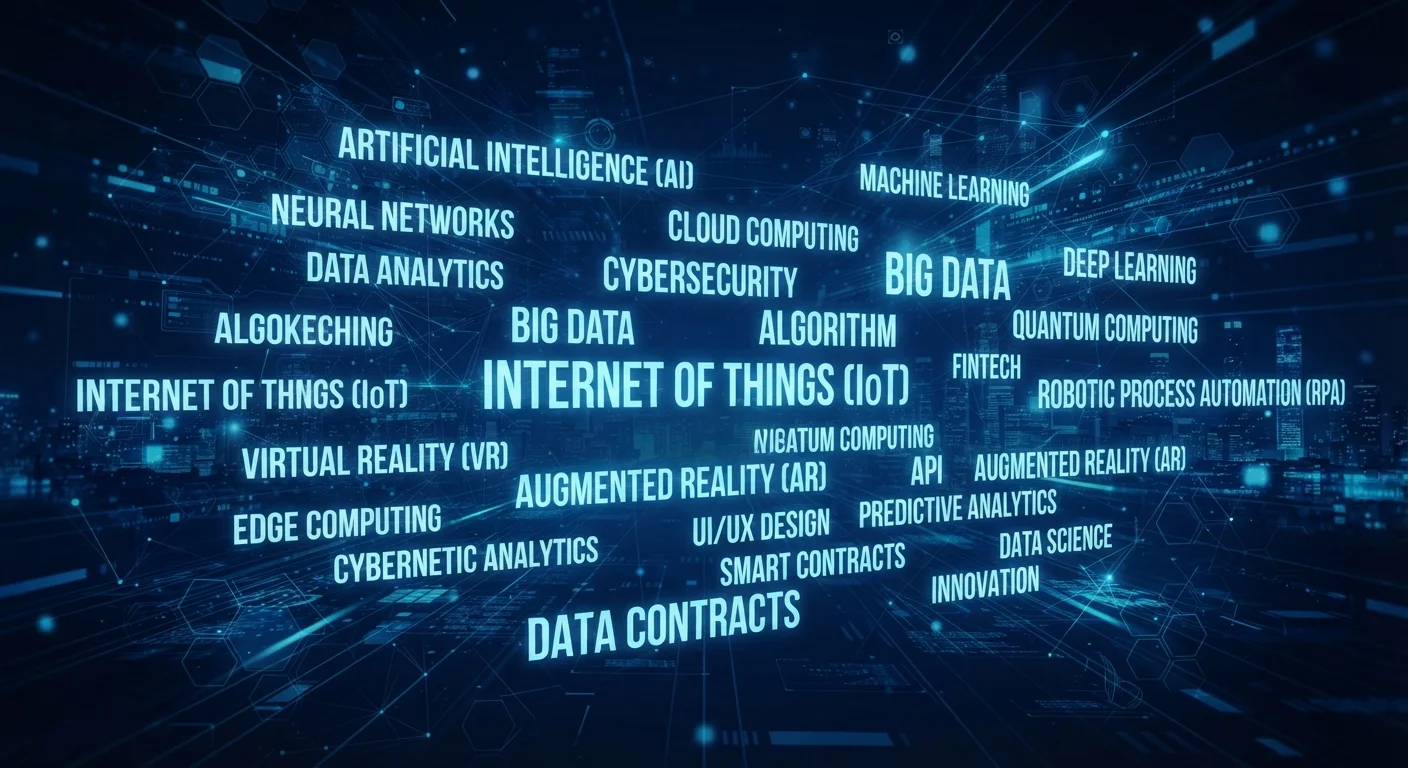
Photo: faqsvault.com editorial
Why Tech Jargon Feels So Overwhelming
Tech trend vocabulary expands faster than almost any other field. Acronyms like LLM, buzzwords like "the metaverse," and shorthand like API appear in news headlines, product announcements, and workplace conversations — often without explanation. The result is a growing gap between people who feel fluent in tech culture and those who quietly nod along hoping context will fill in the blanks.
This glossary bridges that gap. Each entry below focuses on what a term actually means in practical, everyday usage — not its engineering definition. Think of it as a reference card you can return to whenever a conversation or article leaves you uncertain. For a complementary look at device-level vocabulary, see The Everyday Gadget Glossary.
LLM (Large Language Model)
An AI system trained on enormous text datasets to generate, summarize, and respond to written language. ChatGPT and similar chatbots are built on LLMs. They predict likely word sequences based on patterns in their training data rather than understanding language the way humans do.
Blockchain
A distributed database that records transactions as a chain of linked blocks, copied across many computers simultaneously. Because altering one block requires changing all subsequent ones across all copies, the records are highly resistant to tampering.
API
Application Programming Interface — a set of rules that allows one software application to communicate with another. APIs are the invisible connectors that let apps share data and functionality without needing to be built as a single system.
Edge Computing
Processing data close to where it is generated — on a device or local server — rather than sending it to a distant cloud data center. This reduces latency and can improve performance for time-sensitive applications.
Generative AI
A category of AI that produces new content — including text, images, audio, and video — based on patterns learned during training. It differs from AI that only classifies or analyzes existing information.
End-to-End Encryption
A method of securing communications so that only the sender and intended recipient can read a message. The content is encrypted before it leaves the sender's device and decrypted only on the recipient's device.
Web3
A vision for a decentralized internet built on blockchain technology, where users control their own data and digital assets rather than relying on centralized platforms. It remains a contested and evolving concept rather than a finished system.
Spatial Computing
Technology that integrates digital content with the physical world in three-dimensional space, covering augmented reality, virtual reality, and mixed reality applications. It represents a shift from screen-based to environment-based computing.
Zero-Trust Security
A cybersecurity model that requires continuous verification of every user and device, regardless of whether they are inside or outside an organization's network. It assumes no connection is inherently trustworthy.
Digital Twin
A real-time virtual model of a physical object, system, or process, fed by live sensor data. Organizations use digital twins to simulate, monitor, and optimize their real-world counterparts before or during operation.
Prompt Engineering
The skill of writing clear, structured instructions for AI systems to improve the quality and relevance of their outputs. A well-crafted prompt guides the model more effectively than a vague or ambiguous request.
Open-Source Software
Software whose underlying code is publicly available for anyone to inspect, modify, and distribute. Many foundational internet tools and operating systems are open-source, relying on community collaboration rather than a single vendor.
The Terms You're Most Likely to Encounter
The following quick-reference facts capture where these technology concepts currently stand in public conversation and adoption.
| AI market growth | Rapidly expanding across industries (Widely reported across industry analyses, 2023–2024) |
| Primary use of blockchain | Cryptocurrency transaction records (General industry consensus) |
| Web3 status | Emerging and actively debated (Technology policy and industry commentators, 2023) |
| End-to-end encryption adoption | Standard in major messaging apps (Platform documentation, multiple providers) |
| Generative AI business use | Growing in content, coding, and customer service (Enterprise AI adoption surveys, 2023–2024) |
| Edge computing key driver | Low-latency needs (IoT, autonomous vehicles) (Industry analyst reports, general consensus) |
Artificial Intelligence and Machine Learning
Artificial Intelligence (AI) is the broad category for computer systems designed to perform tasks that typically require human-level reasoning — recognizing images, understanding speech, or generating text. Machine learning is a subset of AI where a system improves its performance by finding patterns in large amounts of data, rather than being programmed with explicit rules. Large Language Models (LLMs) are a specific type of AI trained on massive text datasets; they generate fluent human-like text in response to prompts and power many modern chatbots and writing assistants.
The Cloud and Edge Computing
Cloud computing means storing data or running software on remote servers accessed via the internet, rather than on your own device. When you use a streaming service or sync photos automatically, you're using the cloud. Edge computing moves some of that processing closer to where data is generated — on your device or a nearby server — to reduce delays. It matters most for applications that need instant responses, like self-driving vehicle sensors or real-time factory monitoring.
Web3, Blockchain, and Decentralization
Blockchain is a type of database that records information in linked, chronological blocks shared across many computers simultaneously — making it very difficult to alter any single record without changing all subsequent ones. Cryptocurrency is digital currency that uses blockchain to verify and record transactions without a central bank. Web3 is a loose vision for a future internet built on blockchain principles, where users own their own data and digital assets rather than platforms controlling them. The concept remains largely aspirational and actively debated among technologists.
Interoperability and Open Standards
APIs (Application Programming Interfaces) are the connectors that let different software applications share information. When a weather app displays data from a meteorological service, or when you log into a third-party site using your social media account, an API is making that handshake possible. Open-source software is code released publicly so anyone can inspect, modify, or build on it — the opposite of proprietary software whose inner workings are kept private.
Privacy, Security, and Data Concepts
End-to-end encryption scrambles a message on the sender's device and only unscrambles it on the recipient's device, so no one in between — including the messaging platform — can read it. Data sovereignty refers to the idea that data is subject to the laws of the country in which it is collected or stored, a concept that increasingly shapes how global companies handle user information. Zero-trust security is a framework that assumes no user or device should be automatically trusted, even inside an organization's own network — every access request is verified individually.
For strategies on navigating these concepts in daily digital life, the Digital Life Tips hub offers practical, plain-language guidance.
Emerging Terms Worth Watching
Generative AI
Generative AI specifically refers to AI systems that create new content — text, images, audio, or video — rather than simply classifying or analyzing existing content. LLMs are one example; image-generation models are another. The term has entered mainstream business conversation as companies explore both the opportunities and the risks of AI-produced output.
Digital Twin
A digital twin is a virtual replica of a physical object, process, or system, updated in real time using sensor data. Manufacturers use digital twins to simulate how a machine will behave before building it; city planners use them to model traffic flow. The concept is expanding rapidly as sensor networks become cheaper.
Spatial Computing
Spatial computing describes technology that blends digital information with the physical world in three-dimensional space — encompassing AR (augmented reality, which overlays digital elements on the real world), VR (virtual reality, which replaces the real world with a digital environment), and MR (mixed reality, which merges both). The term has gained currency as headset hardware has matured and commercial applications — from training simulations to remote collaboration — have grown clearer.
Prompt Engineering
Prompt engineering is the practice of crafting specific, structured inputs to guide an AI model toward more accurate or useful outputs. As generative AI tools have become common in workplaces, prompt engineering has emerged as a practical skill rather than a purely technical one — the difference between a vague instruction and a well-structured request can dramatically affect an AI tool's usefulness.
If you enjoy building vocabulary across disciplines, you may also find value in the Habit Science Terms glossary, which applies the same plain-language approach to behavioral research.
All published content on this website is for informational and educational purposes only and should not be taken as professional advice. We recommend that readers seek expert opinion before making any decisions. The website is not responsible for any actions taken based on the information provided on this website. We are not liable for any inaccuracies, modifications, or omissions in information. Moreover, external links or third-party content are provided for convenience; we are not liable for their correctness. Users are advised to verify every piece of information before they use it for any purpose.