
Robot Vacuums: The Honest Trade-Offs Nobody Talks About

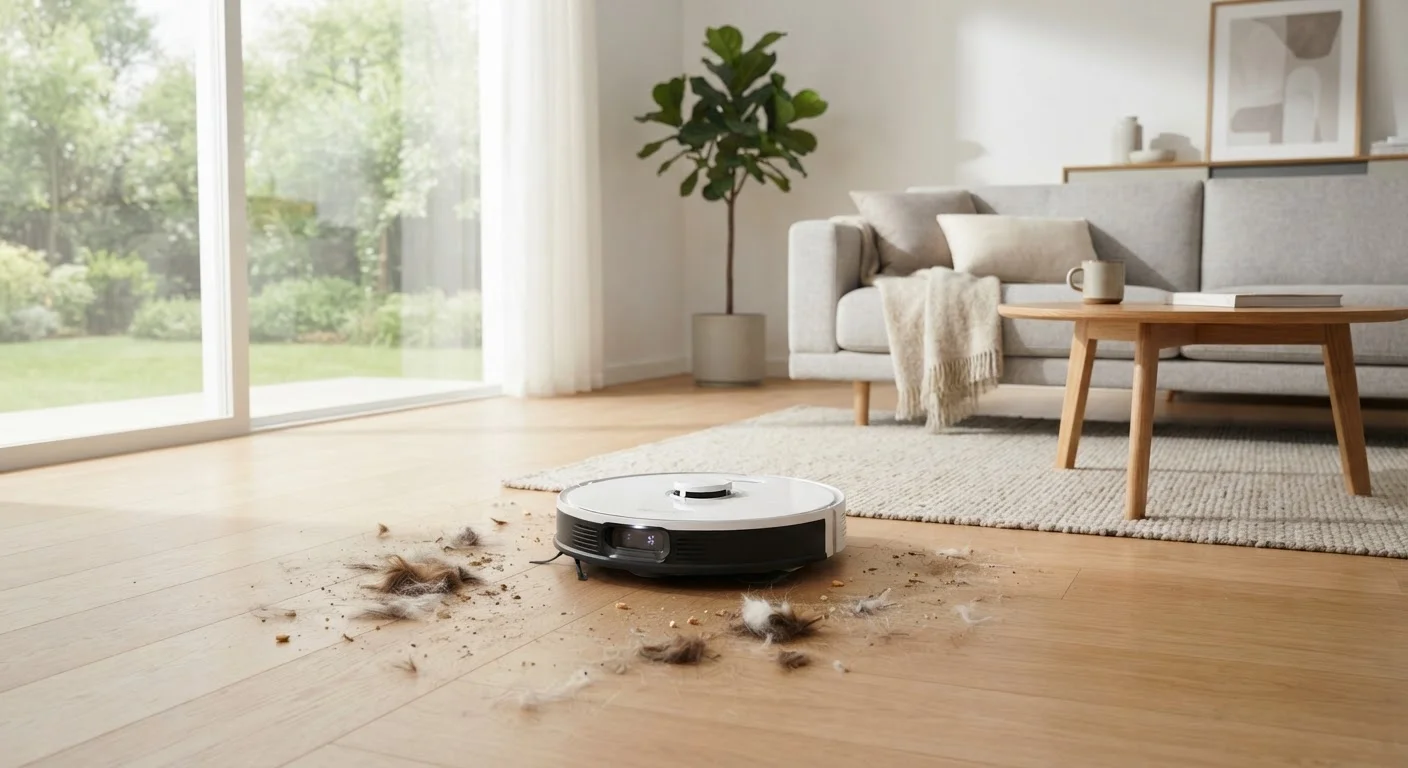
Photo: faqsvault.com editorial
Key Takeaways
- Robot vacuums handle routine maintenance cleaning well but rarely replace a deep-clean session.
- Setup and ongoing maintenance require more effort than most manufacturers suggest.
- Pet owners and open-floor-plan homes tend to get the most practical value from these devices.
- Navigation technology varies significantly and directly affects how reliably a unit cleans.
- The time you save on cleaning may be partially offset by time spent maintaining the robot itself.
Automates routine floor maintenance without daily effort
Scheduled runs keep dust, pet hair, and crumbs under control between manual sessions, reducing how often you need to vacuum manually.
Works well on hard floors and open layouts
Smooth, unobstructed surfaces allow robot vacuums to operate at peak efficiency, making them particularly effective in open-plan living spaces.
Increasingly capable navigation technology
LiDAR and camera-based mapping allow modern units to create accurate home maps, enabling zone-specific cleaning and no-go boundaries set via smartphone apps.
Strong ongoing value for pet owners
Daily automated runs significantly reduce fur accumulation on floors, making them one of the most consistently cited use cases where robot vacuums earn their keep.
Runs while you focus on other tasks
Unlike manual vacuuming, a robot vacuum operates independently — during work calls, cooking, or even while you sleep — returning floor space without interrupting your day.
Struggles with cluttered or high-pile floors
Cables, small objects, and thick rugs frequently stop a run or reduce cleaning effectiveness; the device works best when floors are pre-tidied.
Cannot handle stairs or multi-level homes independently
Every robot vacuum on the market is limited to a single floor level per run, requiring manual repositioning to clean a different floor.
Ongoing maintenance is time-consuming
Brush rolls, filters, and dustbins all need regular attention; in pet households this can mean detangling and emptying every two to three days.
Does not replace deep-cleaning sessions
Robot vacuums are maintenance tools, not thoroughness tools — corners, edges, and high-traffic areas often still require periodic manual attention.
Navigation errors and getting stuck are common
Even higher-end models occasionally misjudge obstacles, get trapped under furniture, or fail to return to their charging base, requiring manual intervention.
Data privacy considerations with mapping models
Camera and LiDAR-equipped units build and often upload detailed interior maps of your home; reviewing the manufacturer's data policy is advisable before setup.
What Robot Vacuums Actually Do Well
The core promise of a robot vacuum is sound: it keeps floors cleaner between your manual sessions without you having to do anything. For everyday dust, pet hair, and crumbs — the kind of mess that accumulates daily — these devices perform reliably. Scheduled runs mean floors are tidier when you wake up or return from work, without any active effort on your part.
Homes with open floor plans and hard flooring see the strongest results. Robot vacuums navigate wide, unobstructed spaces with far fewer hiccups, and smooth surfaces like hardwood, tile, or laminate allow the suction to work at full efficiency. Pet owners, in particular, report noticeable benefits: a daily automated run can dramatically reduce fur build-up between weekly vacuuming sessions.
Modern units have also improved at edge detection, obstacle avoidance, and multi-room mapping. Higher-end models use LiDAR or camera-based navigation to build accurate floor maps, letting you set cleaning zones or no-go areas through an app. These features, once considered premium, are increasingly common across a wider range of price points.
Automates routine floor maintenance without daily effort
Scheduled runs keep dust, pet hair, and crumbs under control between manual sessions, reducing how often you need to vacuum manually.
Works well on hard floors and open layouts
Smooth, unobstructed surfaces allow robot vacuums to operate at peak efficiency, making them particularly effective in open-plan living spaces.
Increasingly capable navigation technology
LiDAR and camera-based mapping allow modern units to create accurate home maps, enabling zone-specific cleaning and no-go boundaries set via smartphone apps.
Strong ongoing value for pet owners
Daily automated runs significantly reduce fur accumulation on floors, making them one of the most consistently cited use cases where robot vacuums earn their keep.
Runs while you focus on other tasks
Unlike manual vacuuming, a robot vacuum operates independently — during work calls, cooking, or even while you sleep — returning floor space without interrupting your day.
The Limitations Most Reviews Gloss Over
The gap between what robot vacuums are marketed to do and what they realistically achieve in a lived-in home is wider than most coverage admits. Cluttered floors are the device's biggest enemy — charging cables, shoes left out, and small toys can stall a run entirely or, worse, get tangled in the brush roll. A robot vacuum quietly assumes your floor is tidy enough to be cleaned.
Thick carpets, high-pile rugs, and transitions between flooring types can reduce effectiveness or cause the unit to get stuck. Stairs are a hard limit for every robot vacuum on the market — they stop at the edge and require you to carry the device between floors. Tight spaces under furniture with low clearance are often missed entirely.
There's also the maintenance overhead that rarely gets highlighted upfront. Brush rolls need detangling every few days in pet households, dustbins fill quickly, and filters require regular replacement. Self-emptying base stations reduce this burden but add to the device's footprint and cost. If you're not keeping up with maintenance, suction performance degrades noticeably.
Struggles with cluttered or high-pile floors
Cables, small objects, and thick rugs frequently stop a run or reduce cleaning effectiveness; the device works best when floors are pre-tidied.
Cannot handle stairs or multi-level homes independently
Every robot vacuum on the market is limited to a single floor level per run, requiring manual repositioning to clean a different floor.
Ongoing maintenance is time-consuming
Brush rolls, filters, and dustbins all need regular attention; in pet households this can mean detangling and emptying every two to three days.
Does not replace deep-cleaning sessions
Robot vacuums are maintenance tools, not thoroughness tools — corners, edges, and high-traffic areas often still require periodic manual attention.
Navigation errors and getting stuck are common
Even higher-end models occasionally misjudge obstacles, get trapped under furniture, or fail to return to their charging base, requiring manual intervention.
Data privacy considerations with mapping models
Camera and LiDAR-equipped units build and often upload detailed interior maps of your home; reviewing the manufacturer's data policy is advisable before setup.
Setup, Software, and the Learning Curve
Out-of-the-box experience varies widely. Entry-level models with random-bounce navigation require minimal setup but deliver inconsistent coverage — some areas get cleaned multiple times while others are skipped. App-connected models with mapping capabilities demand more initial investment: the robot typically needs several exploratory runs before its map of your home is reliable enough to follow cleaning schedules accurately.
Mapping Technology and Privacy
Software updates can both improve and disrupt a robot vacuum's behaviour. A firmware change has occasionally altered navigation behaviour or caused connectivity issues for some users — it's worth checking whether a model has an active update history and a responsive support channel before committing.
Privacy is a consideration that's often overlooked. Camera- and LiDAR-equipped models build detailed maps of your home's interior, and some transmit this data to cloud servers. Reviewing a manufacturer's data and privacy policy before purchase is a reasonable step, particularly for households that are privacy-conscious. This is part of the broader question of how connected home devices handle your data — a topic our everyday gadgets overview addresses in more depth.
Is the Time Savings Real?
The appeal of a robot vacuum is fundamentally about reclaiming time. And to a meaningful degree, that promise holds up — if your floors require vacuuming three or four times a week, automating most of those sessions does return real hours over the course of a month. The device runs while you work, sleep, or are away from home.
~30 min
Average time saved per manual vacuuming session
Consumer research has broadly estimated that robot vacuums can offset two to four manual vacuuming sessions per week for average-sized homes, translating to meaningful cumulative time savings.
~15–20 min
Weekly maintenance time per device
Industry estimates suggest regular upkeep — emptying bins, cleaning brush rolls, and checking filters — typically takes around 15 to 20 minutes per week for most households.
However, the time equation isn't as clean as advertising suggests. You'll spend time on setup, floor-prepping before runs, clearing obstacles, emptying bins, and occasional troubleshooting when the unit gets stuck or misses sections of the room. For some households, these tasks collectively eat into the time savings significantly. The net benefit is real but smaller than the marketing implies — and it scales with how suitable your home is for the device.
It's also worth framing this against what you give up in control. A manual vacuuming session lets you focus on the spots that need it most. A robot follows its programming, which may not always match where your floor actually needs attention that day. That trade-off between autonomy and precision is central to deciding whether a robot vacuum makes sense for your household — much like the structured-versus-flexible tension explored in discussions about structured daily routines.
All published content on this website is for informational and educational purposes only and should not be taken as professional advice. We recommend that readers seek expert opinion before making any decisions. The website is not responsible for any actions taken based on the information provided on this website. We are not liable for any inaccuracies, modifications, or omissions in information. Moreover, external links or third-party content are provided for convenience; we are not liable for their correctness. Users are advised to verify every piece of information before they use it for any purpose.