
Daily Rituals Across Cultures: How Different Societies Structure the Everyday

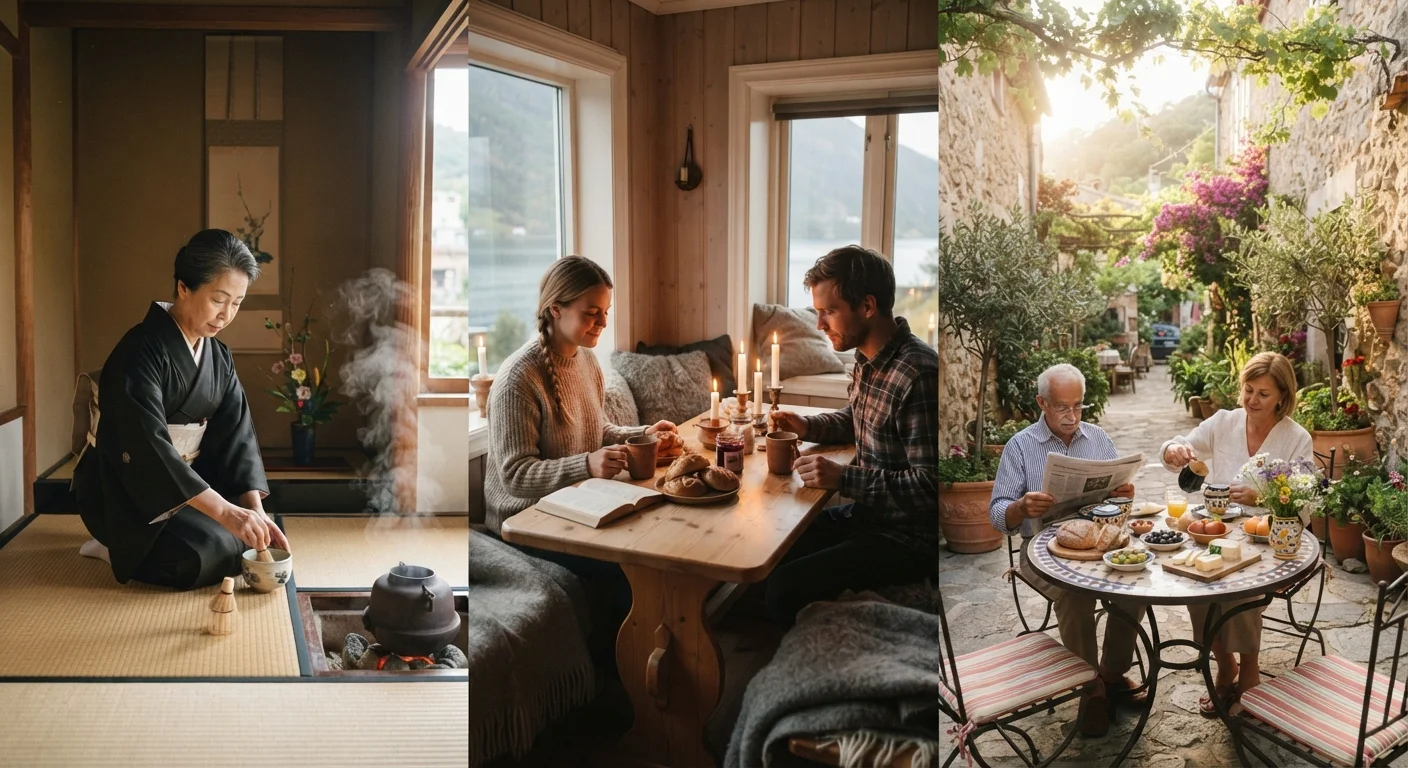
Photo: faqsvault.com editorial
Key Takeaways
- Cultures worldwide use daily rituals to create rhythm, meaning, and a sense of belonging.
- Small, consistent practices — not dramatic overhauls — are how lasting habits actually form.
- You can borrow elements from global traditions and adapt them to fit your own life context.
- Cultural rituals often serve psychological functions: reducing anxiety, strengthening connection, and marking transitions.
- No single culture's approach is universally superior — variety offers a rich menu of inspiration.
Why Daily Rituals Matter More Than We Realize
Every culture on earth structures the day. The particulars differ — what gets eaten, when, with whom, in what silence or noise — but the impulse is universal: humans seem to need rhythm. Rituals create predictability in an uncertain world, and that predictability, researchers in behavioral psychology suggest, helps regulate mood and reduce cognitive load. When a habit becomes ritual, it carries meaning beyond the action itself.
What's striking, when you look across cultures, is how different societies have independently arrived at similar solutions to the same human problem: how do we move through a day with intention rather than just reaction? The answers are varied, occasionally surprising, and often quietly instructive. You don't need to wholesale adopt another culture's routine — but there's genuine value in widening your lens.
If you're thinking about building more structure into your own days, it's worth understanding the real trade-offs first before committing to any framework. What follows is a tour of daily practices from around the world — not a prescription, but an invitation to borrow what resonates.
Japan: Asa-Katsu and the Morning Pursuit
Asa-katsu — literally "morning activity" — is a widespread cultural practice in Japan in which people dedicate the early hours to a personal pursuit: exercise, language study, creative work, or simply a mindful cup of green tea. The logic is practical: mornings are quiet, willpower is fresher, and the activity is done before the demands of the day can crowd it out.
This isn't a productivity hack so much as a philosophy about ownership. The morning hours feel genuinely yours in a way that evenings, often eroded by fatigue and social obligations, rarely do. The ritual also signals a transition — a deliberate step from rest into engagement — which helps the brain shift modes more smoothly.
Mornings feel genuinely yours in a way that evenings rarely do.
Nordic Countries: Hygge and the Evening Wind-Down
Across Denmark, Norway, and Sweden, the concept of hygge (pronounced roughly "hoo-ga") shapes evening culture — an emphasis on coziness, presence, and warm togetherness. Candles, shared meals without screens, slow conversations: hygge isn't an event but an atmosphere, deliberately cultivated after the workday ends.
What hygge offers psychologically is a conscious boundary between work and rest. Rather than letting the evening dissolve into passive scrolling, Nordic practice encourages a physical and social transition into lower-stimulation, higher-connection time. For anyone exploring whether mornings or evenings work better as a habit anchor, the Nordic model makes a compelling case for the evening.
Hygge isn't an event — it's an atmosphere, deliberately cultivated after the workday ends.
Mediterranean Cultures: The Midday Reset
In Spain, Italy, Greece, and across much of the Mediterranean, the middle of the day has traditionally involved a pause — a proper meal, often shared, followed by a short rest. The siesta is perhaps the most famous expression of this, though its practice varies widely and has diminished in urban centers. What endures is the underlying value: the day has a break built into it by design, not accident.
This contrasts sharply with the continuous-day model common in many English-speaking countries, where lunch is frequently eaten at a desk. There's emerging research interest in how meal timing and midday rest may affect alertness and metabolic patterns — though it's worth noting this is an evolving area and individual responses vary considerably. Eating patterns around the world offer a wider lens on how food culture and rhythm intersect.
The Mediterranean day has a break built in by design, not accident.
West Africa: Communal Greeting Rituals
Across many West African cultures, the morning begins not in solitude but in connection. Elaborate greeting exchanges — asking after health, family, sleep, the night — are not small talk but a recognized social ritual that reaffirms relationships and community standing. To skip or rush this exchange would be considered dismissive.
The ritual serves a function that individualistic morning routines often miss: it anchors you not just in your own day, but in your web of relationships. Psychologists who study social connection consistently find that brief, warm interactions at the start of the day can positively affect mood and a sense of belonging. This kind of ritual sits at the intersection of how ritual and tradition sustain a community's sense of self.
Morning greetings in West African cultures aren't small talk — they anchor you in your relationships.
India: The Practice of Sandhyakala Transitions
In many Hindu traditions, the day is organized around sandhya — the three junctions of time: dawn, noon, and dusk. These transitional moments are marked with brief prayers, breath awareness, or simply a pause to notice the shift in light. The practice isn't exclusively religious; the underlying structure has influenced broader Indian daily culture around the significance of transitions as moments worthy of attention.
The idea that how you move between activities matters as much as the activities themselves is increasingly echoed in behavioral science. "Transition rituals" — brief, consistent acts that signal a shift from one context to another — have been studied as a way to improve focus and reduce cognitive spillover between roles (for example, work and home). Even a one-minute pause at a threshold can help the brain re-orient.
How you move between activities may matter as much as the activities themselves.
Finland: Sauna as Weekly Social Ritual
For many Finns, the weekly sauna is less a luxury than a fixture — a time for quiet reflection, bodily care, and unhurried conversation. Historically, the sauna was where important discussions happened, where newborns were welcomed, and where the week was shed before a new one began. It remains one of the most consistent cultural rituals in Finnish life.
What the Finnish sauna tradition illustrates is the power of a recurring, time-bounded ritual that is simultaneously personal and communal. It isn't about optimization; it's about restoration. The regularity is what gives it meaning — not any single session, but the pattern over a lifetime. This is the principle behind all durable rituals: repetition transforms an action into an anchor.
Repetition is what transforms an action into an anchor — not any single session.
Taking What Resonates, Leaving What Doesn't
Cultural rituals are never one-size-fits-all, even within the cultures that created them. They evolve, fracture, and get quietly reinvented by each generation. The value in looking outward isn't to romanticize or appropriate — it's to expand the palette of what feels possible in an ordinary day.
Start With One Borrowed Ritual
Whether it's a five-minute tea moment before your inbox opens, a phone-free dinner, or an intentional wind-down walk at dusk, small anchors compound over time. Research on habit formation consistently points to consistency over intensity: a modest practice you actually repeat matters far more than an ambitious one you abandon. Building a morning routine that actually sticks often comes down to starting smaller than feels meaningful — and trusting the accumulation.
Daily rituals also don't exist in isolation. They sit alongside digital habits and physical habits that together shape your overall wellbeing. The goal isn't a perfect schedule — it's a day that holds enough structure to feel grounding, and enough flexibility to feel human.
This article is for general informational and educational purposes only. It does not constitute medical, psychological, or professional lifestyle advice. Please consult a qualified professional for guidance specific to your circumstances.
All published content on this website is for informational and educational purposes only and should not be taken as professional advice. We recommend that readers seek expert opinion before making any decisions. The website is not responsible for any actions taken based on the information provided on this website. We are not liable for any inaccuracies, modifications, or omissions in information. Moreover, external links or third-party content are provided for convenience; we are not liable for their correctness. Users are advised to verify every piece of information before they use it for any purpose.