
What Makes Something Go Viral? The Anatomy of a Breakout Trend

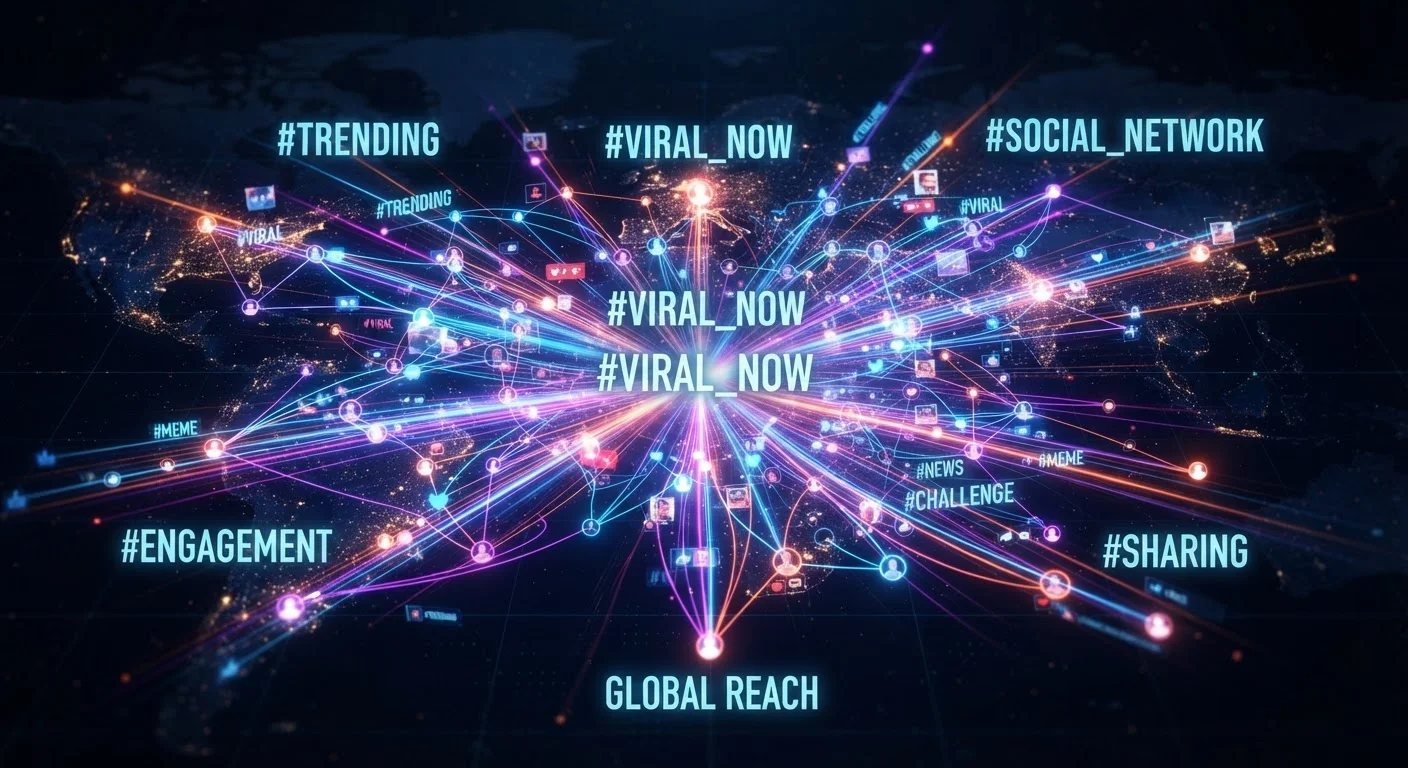
Photo: faqsvault.com editorial
Key Takeaways
- High-arousal emotions — awe, humor, and outrage — reliably drive people to share content.
- Platform algorithms reward early engagement velocity, making timing a critical factor in virality.
- Content that lets people express their identity tends to spread faster and further.
- Influencer amplification can launch a trend, but organic peer-to-peer sharing sustains it.
- Most viral moments fade quickly; only a handful become lasting cultural reference points.
The Viral Myth: Luck vs. Pattern
Ask most people why something goes viral and they'll shrug — right place, right time, they'll say. And while luck certainly plays a role, researchers who study information diffusion have identified a consistent set of conditions that dramatically increase the odds of a breakout moment. Virality isn't a lightning bolt; it's closer to a recipe.
Communications scholar Jonah Berger spent years cataloguing why people share content online and in conversation. His work, along with subsequent studies in network science and media psychology, points to a handful of recurring ingredients: strong emotional activation, social currency, broad relatability, and structural features of the platforms carrying the content. Understanding those elements doesn't guarantee a hit — but it does demystify what looks, from the outside, like pure chance. For a closer look at how this plays out on social media specifically, see how a single tweet becomes a cultural moment.
Emotion: The Engine of Sharing
The most durable finding in viral-content research is this: people share what makes them feel something. But not all feelings are created equal. Psychologists distinguish between high-arousal emotions — awe, amusement, anger, anxiety — and low-arousal ones like sadness or contentment. High-arousal states activate the nervous system and push people toward action, including the action of forwarding a video or hitting the repost button.
Humor is perhaps the most reliable trigger. A well-timed joke bypasses defenses and creates an almost involuntary urge to pass it along. Awe — that feeling of encountering something vast or extraordinary — produces a similar pull. Even outrage, despite its negative valence, generates enormous sharing behavior, particularly on political and social topics.
If you're analyzing why a piece of content spread, always ask what emotion it activated first — not what topic it covered. Emotion is the mechanism; topic is just the container.
Watch how a trend behaves in its second week. If it's still generating new interpretations and remixes, it has genuine cultural traction. If it's only being referenced ironically, the peak has already passed.
What doesn't travel well? Content designed to make the viewer feel embarrassed, guilty, or bored. These emotions lower arousal and reduce the motivation to engage further. Brands and creators who mistake shock for awe, or sadness for emotional depth, often find their content stalls precisely at the edge of broad circulation.
Timing and Platform Mechanics
Emotion gets content moving — but platform architecture determines how far it travels. Every major social platform uses engagement signals to decide what it promotes. Early velocity matters enormously: a post that collects likes and comments within the first hour is far more likely to be surfaced to a wider audience than one that performs adequately but slowly.
6 hrs
Average peak virality window after posting
Studies of social media diffusion patterns suggest most content reaches its maximum spread within the first six hours, underscoring the importance of early engagement.
~1%
Content that achieves true mass virality
Network researchers estimate that only a tiny fraction of shared content crosses the threshold into genuinely widespread, cross-platform viral reach.
3x
Higher share rate for high-arousal emotional content
Content producing high-arousal emotions such as awe or amusement has been found to generate significantly more sharing than neutral or low-arousal content in controlled studies.
This means timing a post — by day of week, hour, and cultural moment — can be the difference between modest reach and runaway spread. Content released during a live event, a trending news cycle, or a cultural flashpoint inherits built-in attention. It's not opportunism so much as alignment: the audience is already primed and gathered.
Platform features also shape what kinds of content win. Short-form video loops favor content that rewards repeat viewing. Duet and stitch features on TikTok turn individual posts into collaborative chains that multiply reach. Retweet quote mechanics on X (formerly Twitter) invite commentary that keeps a conversation alive for days. Understanding the native grammar of each platform — rather than repurposing the same content everywhere — is a pattern found in nearly every studied case of mass-scale virality.
Relatability, Identity, and the "That's Me" Effect
One of the fastest routes to sharing is content that makes someone feel seen. When a meme, video, or post articulates an experience so precisely that the viewer thinks "this is literally my life," the impulse to tag a friend or repost becomes almost reflexive. Researchers sometimes call this the "that's me" effect — content functioning as a social signal that communicates identity to one's network.
This is why hyper-specific content often outperforms generic content at scale. A meme about a very particular kind of work meeting, or a very specific type of childhood memory, resonates more deeply than a broad observation — and deep resonance, paradoxically, travels wider. The niche becomes the mass when enough individual people all feel that private flicker of recognition.
This dynamic also explains why content tied to subculture can erupt into mainstream consciousness. How trends move from subculture to mainstream follows a recognizable pattern: a tight community creates something resonant and specific, outsiders encounter it and feel the pull of novelty, and the cycle accelerates.
The Role of Gatekeepers and Amplifiers
No analysis of virality is complete without acknowledging the role of influential accounts — the accounts with large, engaged followings whose endorsement can transform a piece of content from niche to nationwide. A repost from the right account at the right moment functions like a match held to dry kindling.
But researchers are careful to distinguish between launch and sustain. Influencer amplification can launch a trend, but it rarely sustains one on its own. For content to become truly viral — generating millions of impressions across disconnected networks — it has to achieve peer-to-peer spread: ordinary people sharing with other ordinary people, each acting as a micro-amplifier in their own social circle. That horizontal spread is the signature of genuine virality, as opposed to top-down broadcast reach.
It's also worth noting that virality can be misread in the moment. As reading a cultural moment without jumping to conclusions explores, fast-moving trends are easy to interpret incorrectly before all the context is available.
When Viral Becomes Cultural — and When It Doesn't
Most viral moments have a half-life measured in days. They spike, saturate, and fade — replaced by the next thing before most people have had time to process them. The internet's attention economy is ruthlessly efficient at cycling through content.
A smaller number of viral moments leave a permanent mark: a phrase enters everyday language, a challenge fundraises millions for a cause, a song redefines a genre. What separates these from the forgettable majority? Staying power usually correlates with deeper cultural resonance — the content spoke to something people were already feeling but hadn't yet articulated, or it arrived at a moment of genuine social significance.
The distinction matters because it shapes how we interpret the trends around us. Not every viral moment signals a cultural shift, and why some trends disappear overnight while others reshape society is a question worth sitting with before drawing conclusions. For anyone interested in the broader culture and trends landscape, virality is best understood as a starting point — a signal worth investigating, not a verdict in itself.
All published content on this website is for informational and educational purposes only and should not be taken as professional advice. We recommend that readers seek expert opinion before making any decisions. The website is not responsible for any actions taken based on the information provided on this website. We are not liable for any inaccuracies, modifications, or omissions in information. Moreover, external links or third-party content are provided for convenience; we are not liable for their correctness. Users are advised to verify every piece of information before they use it for any purpose.