
Generative AI vs. Traditional Automation: Understanding the Difference

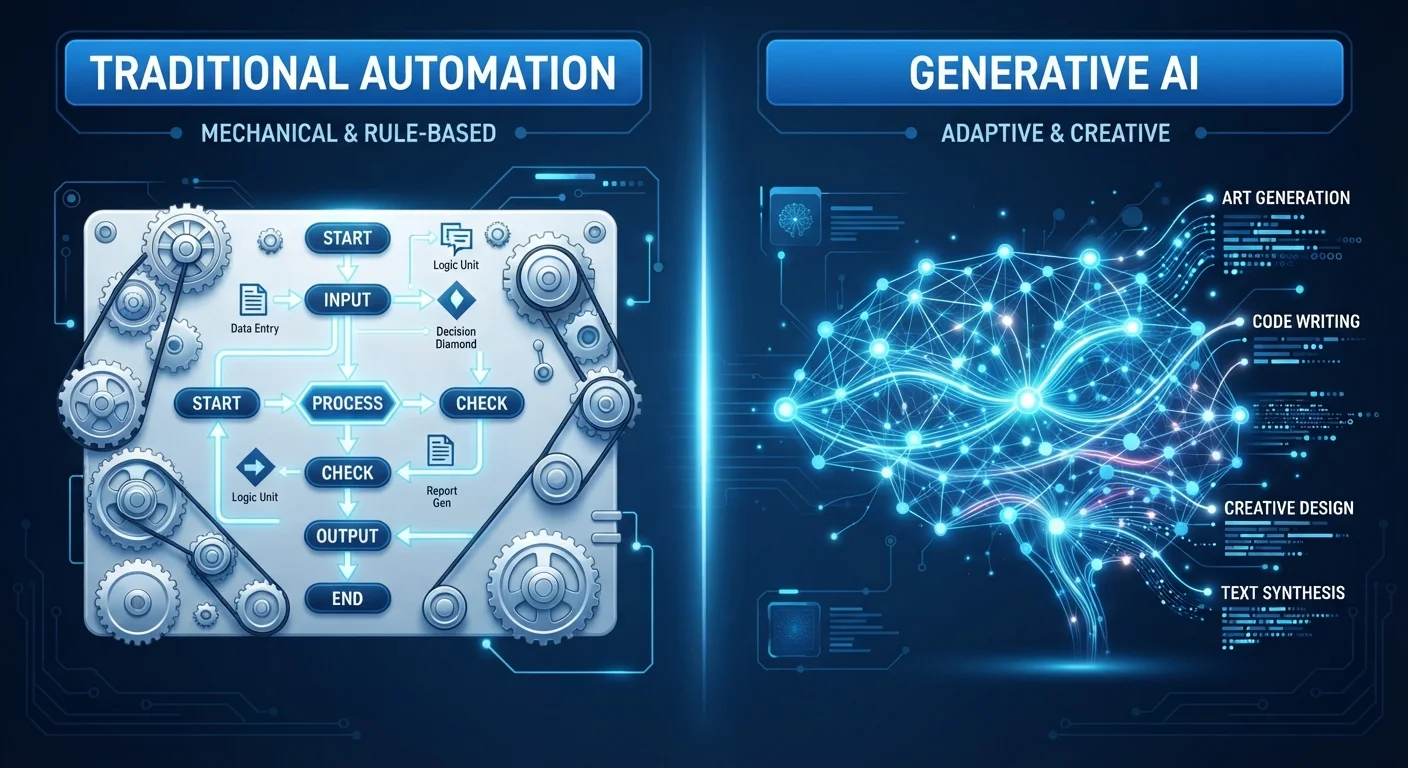
Photo: faqsvault.com editorial
Key Takeaways
- Traditional automation follows explicit, pre-written rules — it cannot operate outside them.
- Generative AI learns patterns from large datasets and produces novel outputs each time.
- The two technologies are not rivals; many real-world systems now combine both approaches.
- Neither technology is universally superior — the right choice depends entirely on the task.
- Understanding the difference helps individuals and organizations make smarter technology decisions.
Two Technologies, Two Very Different Approaches
The terms generative AI and automation get used interchangeably in headlines and boardroom conversations, but they describe fundamentally different technologies. Treating them as synonyms leads to confused expectations — and missed opportunities to use each one effectively.
Traditional automation operates on a simple principle: if this, then that. A developer or engineer defines a precise set of rules, and the system executes them reliably, every time, without deviation. Think of a factory robot that tightens exactly three bolts in exactly the same order, or a payroll system that calculates deductions according to a fixed tax table. The power of traditional automation is its predictability. Its limitation is identical: it cannot handle anything outside the rules it was given.
Generative AI works from a completely different foundation. Rather than following hand-written rules, it is trained on vast amounts of data — text, images, code, audio — and learns statistical patterns within that data. When given a prompt or input, it generates a new response that fits those learned patterns. The output is never simply retrieved from a lookup table; it is constructed in the moment. That's what the word "generative" means in this context.
A Side-by-Side Look at How They Compare
Placing these two technologies side by side makes the practical differences clear. Both can improve efficiency, but they operate at different layers of complexity.
| Criterion | Traditional Automation | Generative AI |
|---|---|---|
| Core mechanism | Explicit, hand-written rules | Patterns learned from training data |
| Output type | Predetermined, consistent | Novel, constructed each time |
| Handles unexpected inputs | Poorly — often fails or errors | Better — adapts to ambiguity |
| Auditability | High — every step is traceable | Lower — outputs are probabilistic |
| Best task type | Structured, repetitive workflows | Open-ended, language-heavy tasks |
| Error profile | Breaks predictably at rule limits | Can produce plausible but wrong output |
| Human oversight needed | Less once deployed and tested | More — outputs should be reviewed |
One distinction worth highlighting is flexibility under uncertainty. Traditional automation breaks — or produces wrong results — when inputs fall outside the expected range. A rule-based customer service chatbot will fail when a user phrases a question in an unexpected way. A generative AI model, by contrast, is designed to handle ambiguity and construct a contextually appropriate reply even when the exact phrasing has never been seen before. That adaptability comes with trade-offs, however: generative AI outputs are probabilistic, meaning they can be wrong, biased by training data, or inconsistent across repeated queries.
Where Each Technology Actually Shows Up in Everyday Life
You interact with both technologies more than you may realize. Traditional automation powers the email filters that sort your inbox, the autopay systems that charge your utility bills on schedule, and the inventory alerts that notify a warehouse when stock runs low. These systems run silently and reliably because their tasks are well-defined.
Generative AI surfaces in tools like conversational assistants, AI-powered writing helpers, image generators, and code completion tools built into developer software. When you ask an AI assistant to summarize a long article or draft a reply to an email, it is generating a response — not retrieving a pre-written one.
Many modern platforms now layer both together. A business might use traditional automation to route a customer support ticket to the right department (rules-based), and then deploy a generative AI model to compose an initial draft response (generative). Neither approach alone would serve as well as the combination. For a deeper look at common misconceptions about what AI can and cannot actually do, see our guide to AI myths.
These Technologies Are Often Combined
What This Means for Everyday Technology Decisions
Understanding the difference matters practically. When an organization announces it is "automating" a process using AI, it's worth asking: is this a rule-based system with a clear decision tree, or a generative model producing open-ended outputs? The answer affects how much human oversight is needed, how errors should be caught, and what kinds of failures to expect.
For individuals, the distinction shapes how much to trust an AI-generated output. A spreadsheet formula that sums a column will always return the correct total — that's deterministic automation. A generative AI tool that drafts a legal summary or a medical explanation may produce something plausible-sounding but subtly incorrect. Both tools are useful; only one requires a careful second look.
Neither technology is going away, and neither is a replacement for critical thinking. Traditional automation will continue to handle the world's structured, repetitive digital labor at scale. Generative AI will keep expanding into tasks that require language, creativity, and contextual reasoning. The savviest approach is knowing which lens to apply — and recognizing that the most powerful systems increasingly use both.
All published content on this website is for informational and educational purposes only and should not be taken as professional advice. We recommend that readers seek expert opinion before making any decisions. The website is not responsible for any actions taken based on the information provided on this website. We are not liable for any inaccuracies, modifications, or omissions in information. Moreover, external links or third-party content are provided for convenience; we are not liable for their correctness. Users are advised to verify every piece of information before they use it for any purpose.