
What 'End-to-End Encryption' Actually Means for Your Messages
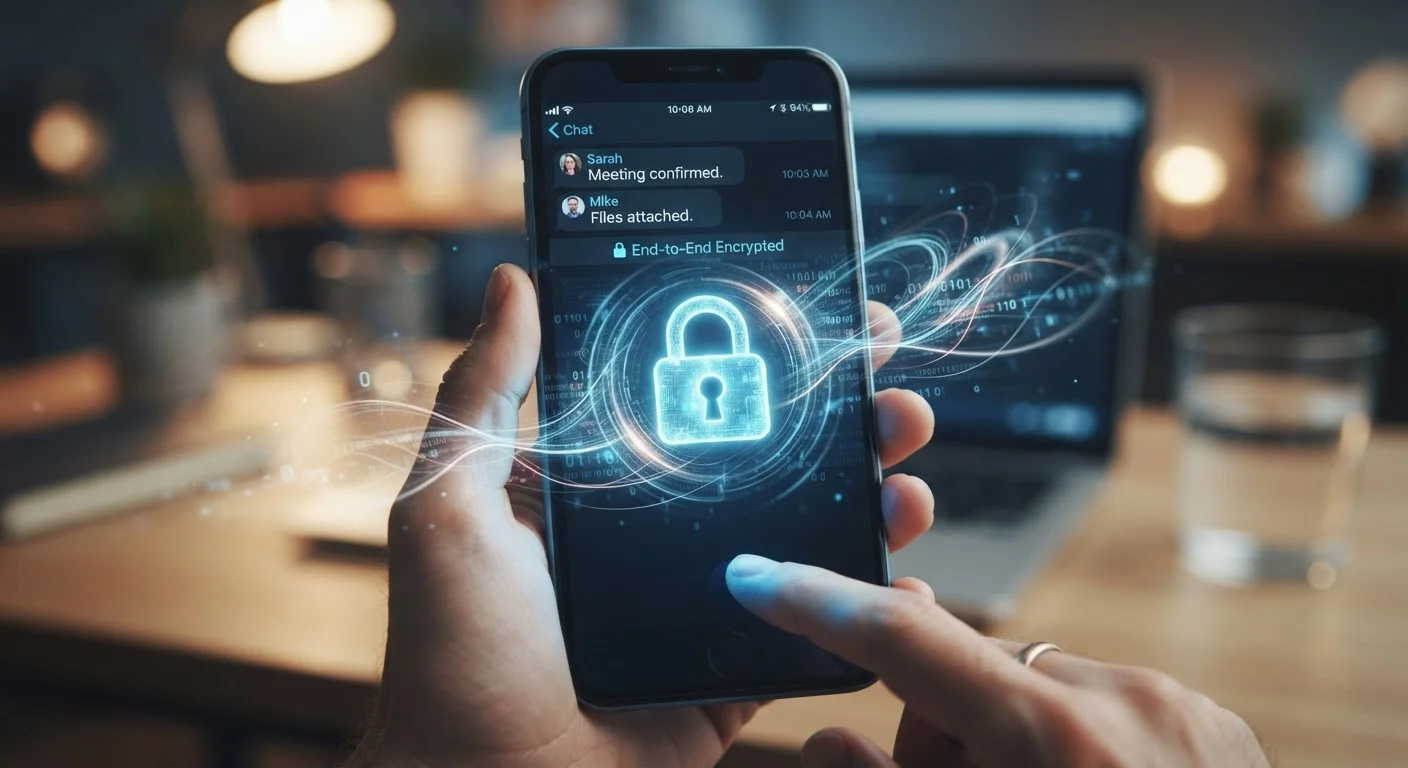
Photo: faqsvault.com editorial
Key Takeaways
- End-to-end encryption ensures only the sender and recipient can read a message's content.
- The messaging app provider itself cannot read your encrypted messages.
- E2EE protects data in transit but does not protect messages once they are stored on an unlocked device.
- Not all messaging apps enable end-to-end encryption by default — some require you to turn it on.
- Encryption does not make you anonymous; metadata like who you messaged and when may still be visible.
The Problem Encryption Is Solving
When you send a message over the internet, it does not travel in a straight, private line from your phone to your friend's. It passes through a series of servers — computers owned by internet providers, telecom companies, and the messaging app itself. Without encryption, any of those intermediary points could, in theory, read your message in plain text.
This is not a hypothetical risk. Unencrypted communications have historically been intercepted by malicious actors, exposed in data breaches, and accessed by companies for advertising purposes. End-to-end encryption was developed specifically to close this gap — ensuring that even if a message is intercepted mid-journey, the interceptor sees nothing but scrambled, unreadable data.
Check Your App's Default Settings
How the Scrambling Actually Works
Encryption works by converting readable text into ciphertext — a jumbled string of characters — using a mathematical algorithm and a unique key. Think of it like a lock-and-key system where only the person with the matching key can open the message.
With end-to-end encryption specifically, two types of keys are involved. A public key is shared openly and is used to lock (encrypt) a message. A private key is kept exclusively on the recipient's device and is used to unlock (decrypt) it. Because the private key never leaves the recipient's device, not even the app's servers can decode the message. The math behind it is designed so that deriving the private key from the public key alone is computationally infeasible with current technology.
What End-to-End Encryption Does Not Protect
Understanding E2EE's limitations is just as important as knowing what it does. The encryption protects the content of messages while they are moving between devices — but several vulnerabilities remain outside its scope.
- Device access: If someone unlocks your phone and opens your messaging app, they can read your messages just as easily as you can. Encryption does not protect data that has already been decrypted on a device.
- Screenshots and forwarding: Once your recipient reads a message, they can copy, screenshot, or forward it. E2EE has no control over what happens after delivery.
- Metadata: Many apps that use E2EE still collect metadata — the who, when, and how often of your conversations — even if they cannot see the content. This information can reveal patterns about your relationships and behavior.
- Backups: Some messaging apps back up conversations to cloud services where encryption may not apply. Check whether your backup settings maintain the same level of protection.
Why This Matters for Everyday Communication
End-to-end encryption is no longer a feature reserved for security experts or journalists. It is built into widely used messaging platforms and protects millions of ordinary conversations daily — from family group chats to sensitive work discussions. Understanding what you are actually protected against helps you make smarter decisions about which apps you use and how you use them.
For most everyday messages, E2EE provides a meaningful and important layer of protection. For highly sensitive matters — medical details, legal conversations, financial information — it is worth combining strong encryption with other habits: keeping your device locked, auditing your backup settings, and being mindful of who you are communicating with and on what platform.
Checking Whether Your App Actually Uses It
Not all messaging apps implement E2EE in the same way, and some do not offer it at all. Standard SMS messages — the built-in text messages sent between phone numbers — do not use end-to-end encryption. They can be read by mobile carriers and are more exposed during transmission.
Many modern messaging apps do encrypt messages by default, though implementations vary. Some encrypt all messages automatically; others require you to start a specific type of conversation to enable the feature. When evaluating an app, look for documentation about its encryption protocol and whether independent security audits have been published. Peer-reviewed, openly documented encryption protocols generally offer more verifiable trustworthiness than proprietary systems whose inner workings are not publicly available.
The label 'encrypted' alone does not tell the full story. The key question is: who holds the decryption keys? If the answer is the company and not your device, the protection is meaningful but not the same as true end-to-end encryption.
Frequently Asked Questions
All published content on this website is for informational and educational purposes only and should not be taken as professional advice. We recommend that readers seek expert opinion before making any decisions. The website is not responsible for any actions taken based on the information provided on this website. We are not liable for any inaccuracies, modifications, or omissions in information. Moreover, external links or third-party content are provided for convenience; we are not liable for their correctness. Users are advised to verify every piece of information before they use it for any purpose.