
Building Equity vs. Building Savings: Two Very Different Paths to Wealth

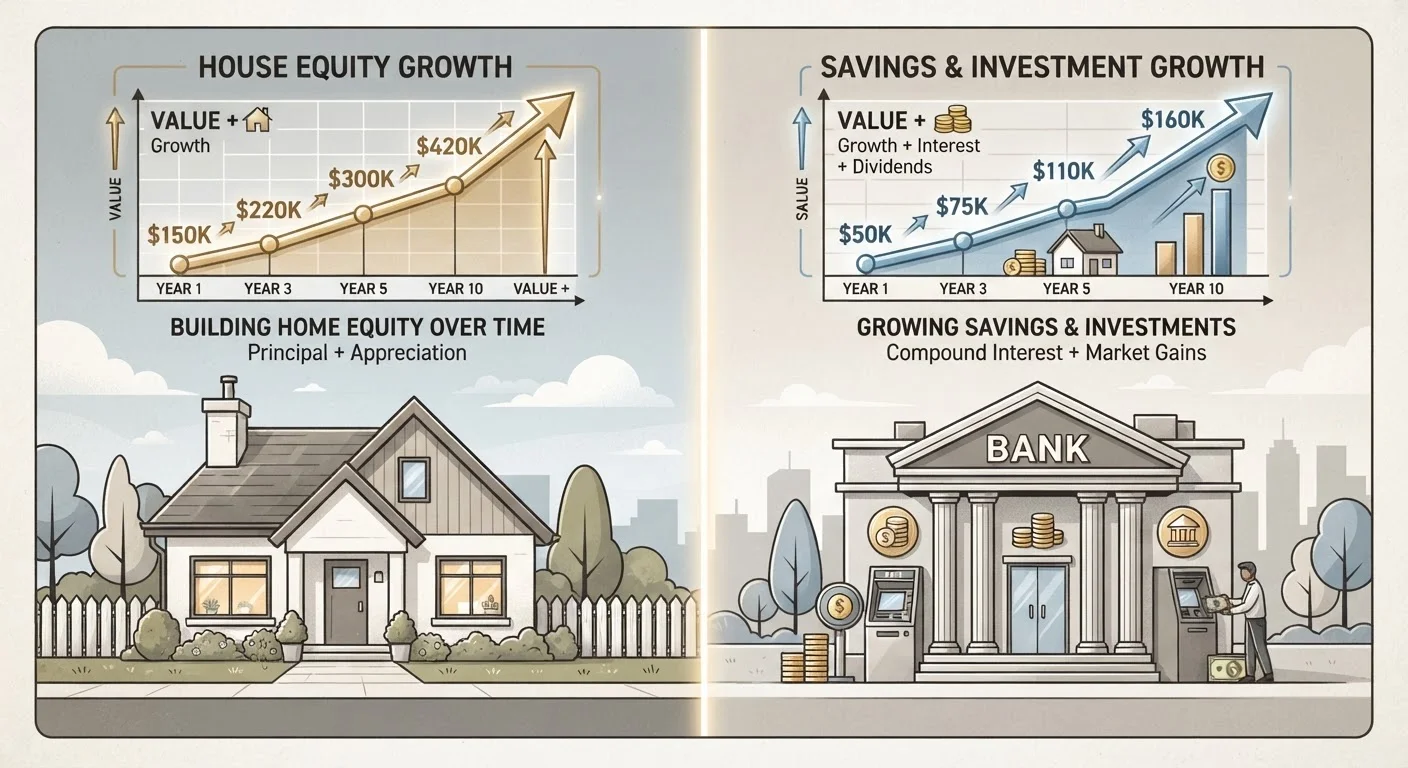
Photo: faqsvault.com editorial
Key Takeaways
- Home equity grows through mortgage paydown and property appreciation, but the wealth is largely illiquid until you sell or borrow against it.
- Investment savings in stocks, bonds, or other vehicles offer greater liquidity and flexibility but no built-in shelter benefit.
- Neither path is universally superior — the right choice depends on your timeline, local market, income stability, and risk tolerance.
- Homeownership carries significant costs — maintenance, taxes, and transaction fees — that erode net equity gains over time.
- Many financially sound households use both strategies simultaneously rather than choosing one over the other.
What Each Path Actually Means
When people talk about building wealth, they typically mean one of two things: accumulating equity in a home, or growing a portfolio of liquid savings and investments. These paths share a destination — financial security — but they operate through entirely different mechanisms.
Home equity is the portion of your property's value that you actually own outright. It equals the home's current market value minus what you still owe on your mortgage. Equity grows in two ways: as you make mortgage payments (which gradually reduce your loan balance) and as the property's market value rises. For a deeper look at how these forces interact, see how equity, mortgage, and ownership relate over time.
Investment savings, by contrast, are financial assets held outside of real estate — think retirement accounts, brokerage accounts, index funds, or high-yield savings. These grow through compound interest, dividends, and market appreciation. Unlike equity, they don't come with a roof over your head, but they tend to be far more liquid — meaning you can access them without selling a property or taking out a loan.
How Equity Builds Wealth Over Time
For most homeowners, equity accumulates slowly in the early years. That's because mortgage amortization — the structure of most home loans — front-loads interest payments. In the first years of a 30-year mortgage, the majority of each monthly payment goes toward interest, with only a small fraction chipping away at the principal balance. This shifts gradually, so equity build-up accelerates as the loan matures.
Property appreciation adds a second engine. Historically, U.S. home values have generally trended upward over long periods, though this varies significantly by region, neighborhood, and market cycle. Appreciation is not guaranteed, and some markets have experienced prolonged flat or declining periods.
What makes equity particularly powerful as a wealth tool is its leverage effect. A buyer who puts 10% down on a $400,000 home controls a $400,000 asset with a $40,000 investment. If the home rises to $440,000, they've gained $40,000 — doubling their initial equity on paper. However, this leverage cuts both ways: if the home's value drops, losses are amplified relative to the down payment.
Homeownership also carries substantial costs that must be subtracted from any equity gains: property taxes, homeowner's insurance, maintenance (typically estimated at 1–2% of home value annually), HOA fees where applicable, and significant transaction costs when buying or selling. A balanced look at owning property as an investment examines these factors in detail.
| Home Equity | Investment Savings | |
|---|---|---|
| Liquidity | Low — requires sale or loan to access | High — typically accessible on short notice |
| Leverage | High — control full asset value with a down payment | None — you invest only what you contribute |
| Forced savings effect | Strong — monthly payments build equity automatically | Requires deliberate, consistent contribution |
| Ongoing costs | Significant — taxes, insurance, maintenance | Minimal — account fees vary by platform |
| Diversification | Low — concentrated in single asset | High — can spread across many asset classes |
| Provides housing | Yes — equity lives in your home | No — separate from housing costs |
| Market risk | Real estate price cycles; regional variation | Stock and bond market volatility |
| Transaction costs | High — typically 6–10% of home value to sell | Low — minimal trading or withdrawal fees |
How Investment Savings Build Wealth Over Time
Liquid savings and investments grow primarily through compound returns — the process by which gains generate their own gains over time. The longer the time horizon, the more powerful this effect becomes. A consistent monthly contribution to a diversified investment account, made over decades, can accumulate substantial wealth even without the leverage inherent in real estate.
The key advantages of investment savings are flexibility and diversification. If circumstances change — a job loss, a health crisis, a desire to relocate — liquid assets can be accessed or restructured without the friction and cost of a real estate transaction. This is why financial planners often emphasize liquid reserves before or alongside homeownership. For context on how saving and investing differ from one another, this comparison of saving vs. investing breaks down the risk and time-horizon differences clearly.
Investment savings also carry risk — market values fluctuate, and short-term downturns can be significant. Unlike a home, a brokerage account doesn't shelter your family, and there's no equivalent of rental income unless you hold dividend-producing assets. For renters who choose this path over homeownership, the math only works if the savings discipline is actually maintained. The full financial comparison of renting vs. owning explores this tradeoff in depth.
The Case for Doing Both
In practice, many households don't choose one path exclusively. Homeowners who also invest regularly in retirement accounts or other vehicles enjoy equity's forced-savings structure alongside the liquidity and diversification that investment portfolios provide. This dual approach tends to produce more resilient financial positions than either path alone.
The challenge, of course, is affordability. In many U.S. housing markets, monthly homeownership costs leave little room for additional saving and investing. This is where a balanced view of homeownership as a financial asset is useful — acknowledging that for some buyers in some markets, renting and investing the difference may produce comparable or better financial outcomes over time.
For those working to build any kind of financial cushion, foundational habits matter regardless of which wealth path you pursue. Sinking funds and emergency reserves, for example, create the financial breathing room that makes either strategy more sustainable.
This article is for general informational and educational purposes only and does not constitute personalized financial, investment, tax, or legal advice. Readers should consult a qualified financial adviser or other licensed professional before making decisions based on their individual circumstances.
All published content on this website is for informational and educational purposes only and should not be taken as professional advice. We recommend that readers seek expert opinion before making any decisions. The website is not responsible for any actions taken based on the information provided on this website. We are not liable for any inaccuracies, modifications, or omissions in information. Moreover, external links or third-party content are provided for convenience; we are not liable for their correctness. Users are advised to verify every piece of information before they use it for any purpose.