
Cash Flow vs. Profit: The Distinction That Trips Up New Owners

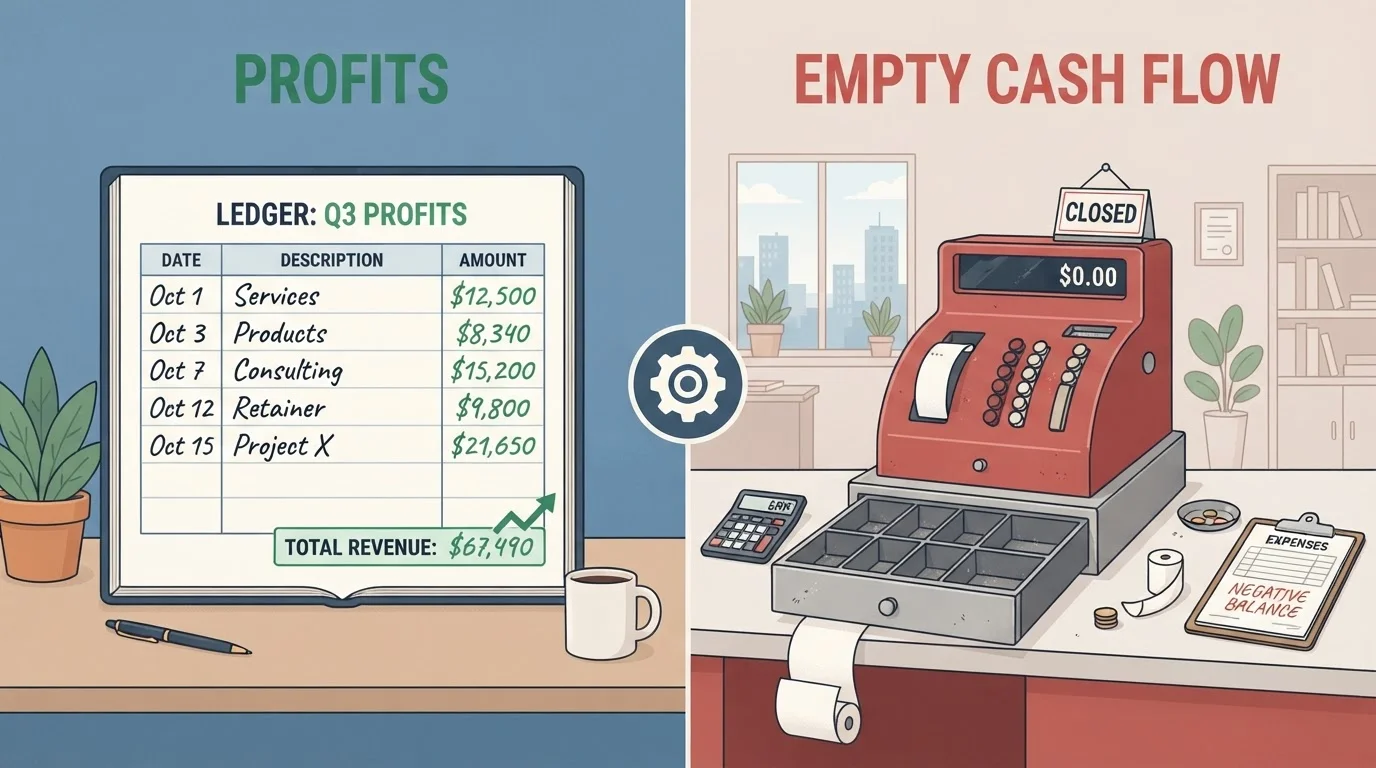
Photo: faqsvault.com editorial
Key Takeaways
- A business can show a profit on paper while simultaneously running out of cash to operate.
- Cash flow tracks actual money moving in and out; profit measures revenue minus expenses over a period.
- Timing differences — like invoices paid late — are the most common cause of profitable-but-broke situations.
- Most early business failures trace back to cash flow problems, not unprofitability.
- Monitoring both metrics separately is essential; one cannot substitute for the other.
Why the Confusion Happens in the First Place
Most new business owners intuitively assume that making money and having money are the same thing. They're not — and that gap is where many early ventures quietly collapse. As part of the broader financial concepts every new business owner should know, understanding cash flow versus profit is arguably the most urgent lesson.
Here's a simple scenario: You complete a $10,000 project in January, invoice the client, and record it as revenue. Your profit statement looks great. But the client pays Net-60 — meaning payment arrives in March. Meanwhile, you owe your suppliers and staff in February. On paper, you're profitable. In your bank account, you're short. That's the cash flow problem in its most common form.
This isn't a fringe scenario. It's the standard experience for small businesses that work with invoices, purchase inventory in advance, or carry receivables. Research into early business failure consistently identifies cash flow mismanagement — not an unviable product or bad market — as a leading cause of closure.
Defining Each Term Clearly
Profit is what remains after you subtract all business expenses from total revenue over a given period. It appears on your income statement (also called a profit and loss statement, or P&L). There are two common versions: gross profit, which subtracts only the direct costs of producing your goods or services, and net profit, which subtracts all operating expenses, taxes, and interest as well. Profit is a backward-looking measure — it summarises what happened over a period, typically a month, quarter, or year.
Cash flow refers to the actual movement of money into and out of your business during a specific timeframe. It's tracked on a cash flow statement and broken into three categories: operating activities (day-to-day business), investing activities (buying or selling assets), and financing activities (loans, owner contributions). Positive cash flow means more money came in than went out. Negative cash flow means the opposite — regardless of what your profit figures say.
| Criterion | Cash Flow | Profit |
|---|---|---|
| What it measures | Actual money in and out | Revenue minus expenses |
| Accounting basis | Cash basis (when paid) | Accrual basis (when earned) |
| Key financial statement | Cash flow statement | Income statement (P&L) |
| Time orientation | Current and near-term | Historical period summary |
| Can be positive while the other is negative? | Yes — cash positive, profit negative | Yes — profitable but cash-poor |
| Primary risk it reveals | Inability to pay immediate obligations | Unsustainable business model |
The core distinction: profit is calculated using accrual accounting, which records revenue when it's earned and expenses when they're incurred, regardless of when cash actually changes hands. Cash flow only cares about actual dollars received or paid. For a plain-language primer on terms like these, the Language of Personal Finance guide offers useful grounding.
The Timing Problem: Where Things Go Wrong
The most dangerous gap between profit and cash flow comes down to timing. Consider three common situations new owners encounter:
- Slow-paying clients: You've delivered the work and recorded the revenue, but cash won't arrive for 30, 60, or 90 days. Meanwhile, expenses keep coming.
- Inventory purchases: A retailer buying stock for a busy season pays out cash long before those goods are sold and revenue is recognised.
- Upfront costs for long-term contracts: You might hire staff or buy equipment to service a contract that pays out monthly over a year. The expenses hit now; the income trickles in slowly.
Profitable Businesses Can and Do Fail
Each of these situations can generate a "profitable but broke" outcome. The fix isn't always to grow faster — sometimes growth accelerates the cash crunch by increasing upfront costs faster than incoming payments catch up.
How to Track Both Without Overcomplicating It
You don't need complex software to stay on top of both metrics, though accounting tools can help. Here's a practical starting framework:
- Review your P&L monthly. This tells you whether your revenue-to-expense ratio is healthy and whether your pricing is working.
- Build a 13-week cash flow forecast. This simple spreadsheet lists expected cash inflows and outflows week by week for the next quarter. It turns invisible problems into visible ones before they become emergencies.
- Track your accounts receivable aging. Know exactly which invoices are outstanding and how overdue they are. A profitable business with slow-paying clients is a vulnerable business.
- Keep a cash reserve. Most financial guidance suggests small businesses maintain at least one to three months of operating expenses in accessible reserves — though your specific situation will vary, so consult a financial professional for personalised guidance.
The full picture of small business ownership involves managing many financial levers at once, but cash flow monitoring is the non-negotiable daily habit. Even home-based businesses aren't immune — running a business from home still requires the same cash discipline as any commercial operation.
This article is for general informational and educational purposes only and does not constitute financial, legal, or accounting advice. Consult a qualified financial professional for guidance specific to your business situation.
All published content on this website is for informational and educational purposes only and should not be taken as professional advice. We recommend that readers seek expert opinion before making any decisions. The website is not responsible for any actions taken based on the information provided on this website. We are not liable for any inaccuracies, modifications, or omissions in information. Moreover, external links or third-party content are provided for convenience; we are not liable for their correctness. Users are advised to verify every piece of information before they use it for any purpose.