
Solid Wood vs. Engineered Flooring: Performance, Installation, and Longevity

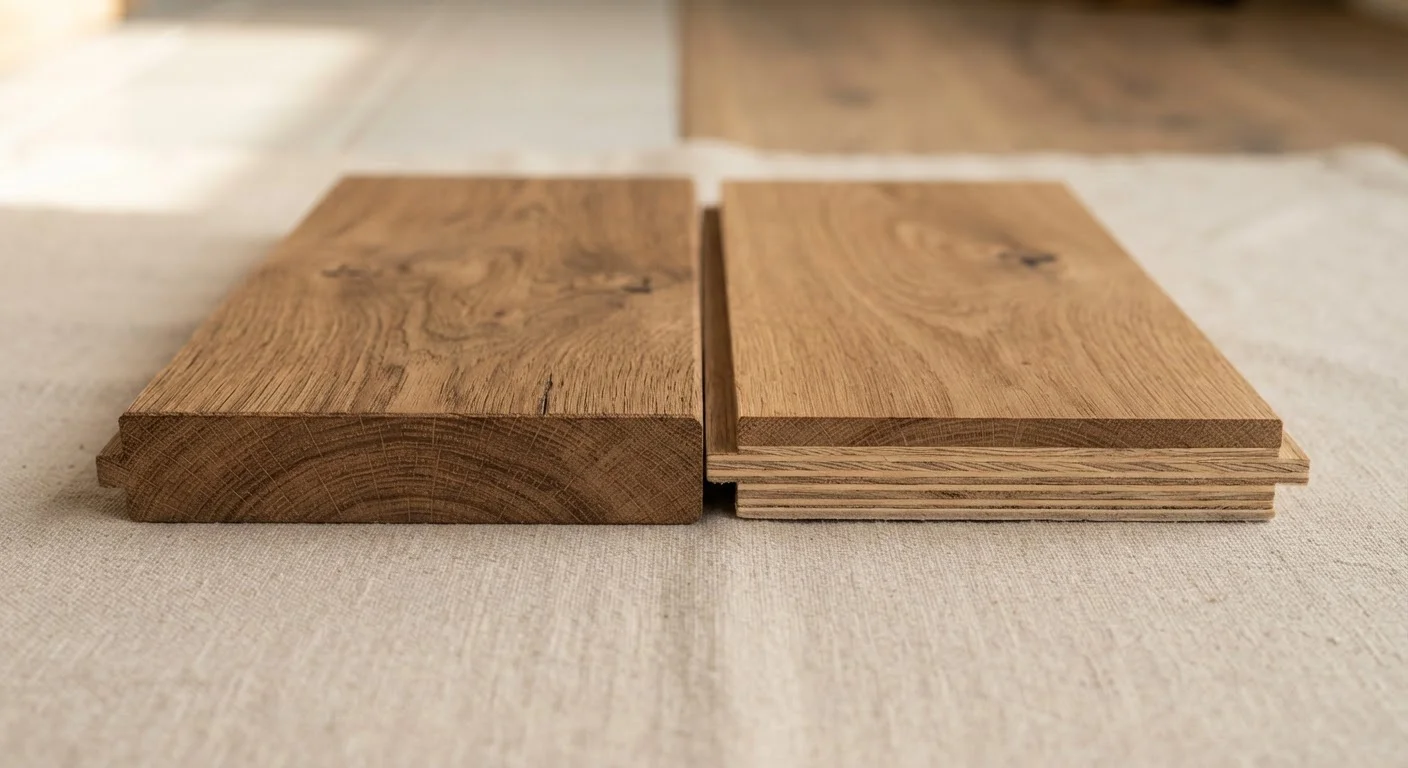
Photo: faqsvault.com editorial
Key Takeaways
- Solid wood is milled from a single piece of timber and can typically be sanded and refinished multiple times over decades.
- Engineered wood uses a real hardwood veneer bonded over a plywood or composite core, making it far more resistant to moisture and temperature changes.
- Engineered flooring is generally compatible with radiant heat systems and can be installed below grade; solid wood is not recommended for either.
- Installation methods differ significantly — solid wood is usually nailed or stapled, while engineered options can be glued, floated, or fastened.
- Both types can look identical once installed; the performance gap only becomes apparent over time or under challenging conditions.
- Neither option guarantees infinite longevity — wear layer thickness and maintenance practices determine how long each floor actually lasts.
What's Actually Inside Each Plank
Despite looking nearly identical once installed, solid and engineered wood floors are structurally very different products. Solid wood flooring is exactly what the name suggests: each plank is milled from a single piece of timber from top to bottom, typically 3⁄4 inch thick. That uniform construction gives it a characteristic density and allows significant material to be removed during sanding and refinishing.
Engineered wood, by contrast, is a layered composite. A top veneer of real hardwood — the species you see and walk on — is bonded under heat and pressure to multiple cross-directional plies of plywood or a high-density fiberboard core. The cross-ply construction is the key engineering insight: alternating grain directions counteract the natural tendency of wood to expand and contract as humidity changes. The result is a plank that resists warping, cupping, and gapping far more effectively than solid wood.
The hardwood veneer on engineered products varies in thickness, typically ranging from 2mm to 6mm. Thicker wear layers allow for at least one or two refinishing passes; thinner veneers may not survive even one sanding. Always confirm the wear layer specification before purchasing if refinishing is a priority for you.
Performance Under Real Conditions
The practical performance gap between these two options becomes most apparent under environmental stress. Solid wood absorbs and releases moisture from the air, which causes it to swell in humid summers and shrink during dry winters. In an above-grade living room with stable climate control, this seasonal movement is manageable. In a basement, laundry room, kitchen, or bathroom — or in a region with dramatic humidity swings — it can lead to buckling, cupping, or gapping that no amount of acclimation will fully prevent.
Engineered wood handles these conditions significantly better. Its core construction limits dimensional movement, making it a viable choice for below-grade spaces and areas with moderate moisture exposure. It is also the appropriate product for use over radiant heat systems, where the floor experiences repeated heating cycles that would stress solid wood over time.
| Criterion | Solid Wood | Engineered Wood |
|---|---|---|
| Construction | Single piece of timber | Hardwood veneer over plywood core |
| Moisture resistance | Low — expands and contracts | Moderate — dimensionally stable |
| Below-grade suitability | Not recommended | Generally suitable |
| Radiant heat compatibility | Not recommended | Compatible (product-dependent) |
| Refinishing potential | High — 5 to 8+ times | Limited by wear layer thickness |
| Installation methods | Nail-down or staple-down | Nail, glue, or float |
| DIY accessibility | Moderate — requires power tools | Higher — click-lock systems available |
| Typical plank thickness | ¾ inch | ⅜ to ¾ inch |
Neither product belongs in a space with standing water or chronic flooding risk — that situation calls for tile, luxury vinyl, or another waterproof category. But for the wide middle ground of variable-humidity residential spaces, engineered wood provides meaningful real-world advantages over solid wood.
Installation Methods and Skill Requirements
How each floor is installed affects both the project's complexity and the floor's long-term performance. Solid wood flooring is almost always installed using a nail-down or staple-down method, requiring a pneumatic flooring nailer and a wooden subfloor thick enough to hold fasteners — typically at least 3⁄4-inch plywood. This method produces a very stable, quiet result, but it demands some tool familiarity and physical effort, particularly around transitions and edges.
Engineered wood offers more installation flexibility. Depending on the product, it can be nailed or stapled (like solid wood), glued down with flooring adhesive, or floated — meaning the planks lock together and rest freely on the subfloor without being fastened to it. Floating installations using click-lock engineered planks are among the most accessible DIY flooring projects available, and they also allow for easier removal or replacement down the road.
Both types require proper subfloor preparation: a flat, clean, structurally sound surface is non-negotiable. Solid wood also requires acclimation — leaving the planks in the installation room for several days to equalize with local humidity levels. Some engineered products recommend this as well; follow the manufacturer's specific guidance. Skipping acclimation is a common cause of post-installation problems with either floor type.
Longevity and Refinishing Potential
Longevity depends on two separate questions: how long the floor holds up structurally, and how many times you can restore its surface appearance through sanding and refinishing. On the first count, a well-installed solid wood floor in appropriate conditions can last the lifetime of a house. On the second, a 3⁄4-inch solid plank can typically be sanded five to eight times before reaching the tongue-and-groove fastening system — a significant refinishing reserve.
Engineered wood's refinishing potential depends entirely on its wear layer. A 2mm veneer may allow one careful sanding; a 6mm veneer may allow two or three. If you plan to refinish a floor over decades, this difference matters enormously. However, engineered floors in good condition with a factory finish can go many years between refinishes when properly maintained, and many homeowners replace flooring before reaching the limit of even a thin wear layer.
Surface finish maintenance — regular cleaning, felt pads on furniture, area rugs in high-traffic zones — extends the life of both types considerably. Neglect accelerates finish wear regardless of which product is underfoot. Before committing to either option, consider how the room will actually be used day-to-day, not just how it will look at installation.
All published content on this website is for informational and educational purposes only and should not be taken as professional advice. We recommend that readers seek expert opinion before making any decisions. The website is not responsible for any actions taken based on the information provided on this website. We are not liable for any inaccuracies, modifications, or omissions in information. Moreover, external links or third-party content are provided for convenience; we are not liable for their correctness. Users are advised to verify every piece of information before they use it for any purpose.